Blog

  • What’s in style now?

    Fashion is a popular style or practice, especially in clothing, footwear, accessories, makeup, body, or furniture. Fashion is a distinctive and often constant trend in the style in which a person dresses. It is the prevailing styles in behaviour and the newest creations of textile designers. Because the more technical term costume is regularly linked to the term «fashion», the use of the former has been relegated to special senses like fancy dress or masquerade wear, while «fashion» generally means clothing, including the study of it. Although aspects of fashion can be feminine or masculine, some trends are androgynous.

    Early Western travelers, traveling whether to Persia, Turkey, India, or China, would frequently remark on the absence of change in fashion in the respective places. The Japanese Shogun’s secretary bragged (not completely accurately) to a Spanish visitor in 1609 that Japanese clothing had not changed in over a thousand years.However, there is considerable evidence in Ming China of rapidly changing fashions in Chinese clothing. Changes in costume often took place at times of economic or social change, as occurred in ancient Rome and the medieval Caliphate, followed by a long period without major changes. In 8th-century Moorish Spain, the musician Ziryab introduced to Córdoba .unreliable source sophisticated clothing-styles based on seasonal and daily fashions from his native Baghdad, modified by his own inspiration. Similar changes in fashion occurred in the 11th century in the Middle East following the arrival of the Turks, who introduced clothing styles from Central Asia and the Far East

    The beginning in Europe of continual and increasingly rapid change in clothing styles can be fairly reliably dated. Historians, including James Laver and Fernand Braudel, date the start of Western fashion in clothing to the middle of the 14th century,  though it should be noted that they tend to rely heavily on contemporary imagery and illuminated manuscripts were not common before the fourteenth century. The most dramatic early change in fashion was a sudden drastic shortening and tightening of the male over-garment from calf-length to barely covering the buttocks ,sometimes accompanied with stuffing in the chest to make it look bigger. This created the distinctive Western outline of a tailored top worn over leggings or trousers.

  • What we do is simple and elegant design

    One possible origin of design can be found in the early 16th century. At the beginning of the modern era, the idea emerged that society could be shaped through the design of the living environment. A God-given order did not determine our lives; it was rather people who shaped the world—this, at least, was the basic idea. An excellent example of it can be found in the philosophical work Utopia, in which Thomas More (1478–1535) created an ideal society.1 This society’s realization depended on the way cities, villages, and settlements were arranged, and the way houses, furnishings, clothing, and meals were configured. Today, all of that is included in design.

    Another possible origin of design is discernable in the late 18th century. During the Enlightenment, many rulers tried to improve their states and educate their subjects according to their perceptions of the ideal. To that end, they trained artists, craftspeople, and producers, who, following the ancient Greek model, were meant to make objects for everyday use, thereby strengthening the economy and cultivating “good taste” in the populace.2 In the design of these objects, the desire for economic growth was combined with moral goals. The rulers’ humanistic ideals were meant to be passed on to the subjects through everyday objects. This linking of the moral and economic reappears in almost all later periods of design.

  • The Diamond wedding dress

    Wedding gown is the clothing worn by a bride during a wedding ceremony. Color, style and ceremonial importance of the gown can depend on the religion and culture of the wedding participants. In Western cultures, brides often choose white wedding dress, which was made popular by Queen Victoria in the 19th century. In eastern cultures, brides often choose red to symbolize auspiciousness.

    Weddings performed during and immediately following the Middle Ages were often more than just a union between two people. They could be a union between two families, two businesses or even two countries. Many weddings were more a matter of politics than love, particularly among the nobility and the higher social classes. Brides were therefore expected to dress in a manner that cast their families in the most favorable light and befitted their social status, for they were not representing only themselves during the ceremony. Brides from wealthy families often wore rich colors and exclusive fabrics. It was common to see them wearing bold colors and layers of furs, velvet and silk. Brides dressed in the height of current fashion, with the richest materials their families’ money could buy. The poorest of brides wore their best church dress on their wedding day. The amount and the price of material a wedding dress contained was a reflection of the bride’s social standing and indicated the extent of the family’s wealth to wedding guests.

    Many wedding dresses in China, India (wedding sari), Pakistan (heavily embroidered shalwar qameez or lehngas) and Vietnam (in the traditional form of the Ao dai) are red, the traditional colour of good luck and auspiciousness. Nowadays, many women choose other colours besides red. In modern mainland Chinese weddings, the bride may opt for Western dresses of any colour, and later don a traditional costume for the official tea ceremony.

    In modern Taiwanese weddings, the bride generally picks red (following Chinese tradition) or white (more Western) silk for the wedding gown material, but most will wear the red traditional garment for their formal wedding banquets. Traditionally, the father of the bride is responsible for the wedding banquet hosted on the bride’s side and the alcohol (specifically called «xi-jiu,» confusingly the same as what the wedding banquet itself is called) consumed during both banquets. While the wedding itself is often based on the couple’s choices, the wedding banquets are a symbolic gesture of «thanks» and appreciation, to those that have raised the bride and groom (such as grandparents and uncles) and those who will continue to be there to help the bride and groom in the future. Thus out of respect for the elders, wedding banquets are usually done formally and traditionally.

    Red wedding saris are the traditional garment choice for brides in Indian culture. Sari fabric is also traditionally silk. Over time, colour options and fabric choices for Indian brides have expanded. Today fabrics like crepe, Georgette, charmeuse, and satin are used, and colors have been expanded to include gold, pink, orange, maroon, brown, and yellow as well. Indian brides in Western countries often wear the sari at the wedding ceremony and change into traditional Indian wear afterwards (lehnga, choli, etc.).

    A Japanese wedding usually involves a traditional pure white kimono for the formal ceremony, symbolizing purity and maidenhood. The bride may change into a red kimono for the events after the ceremony for good luck.

    In the Philippines, variations of the Baro’t saya adapted to the white wedding tradition are considered to be wedding attire for women, along with the Barong Tagalog for men. Various tribes and Muslim Filipinos don other forms of traditional dress during their respective ceremonies.

  • Trump: la humillación a México

    "Doble muro en Tijuana". Foto: Jonathan McIntosh.
    «Doble muro en Tijuana». Foto: Jonathan McIntosh.

    Por: Álvaro Cuadra – enero 27 de 2017

    Una semana antes de que el presidente mexicano arribara a Washington para dialogar con el flamante presidente de los Estados Unidos ha recibido una bofetada diplomática: Trump ha firmado ya la orden ejecutiva que da luz verde a la construcción del muro fronterizo con su vecino del sur. Este insulto debiera hacer reflexionar a todos las cancillerías latinoamericanos sobre cómo serán las relaciones con su vecino del norte en los próximos años.

    (más…)

  • El ‘borracho’

    "-Doctor Juan Carlos, váyase derechito a la Clínica Monserrat y diga que estaba muy borracho durante la entrevista...". Caricatura: Átomo Cartún.
    «-Doctor Juan Carlos, váyase derechito a la Clínica Monserrat y diga que estaba muy borracho durante la entrevista…». Caricatura: Átomo Cartún.
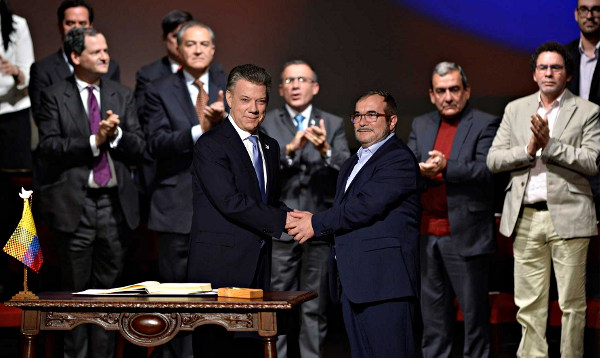
  • Los retos de la paz

    Juan Manuel antos y Rodrigo Londoño 'Timochenko' se dan la mano durante el acto de firma del acuerdo de paz en el Teatro Colón de Bogotá. Foto: Efraín Herrera, presidencia.
    Juan Manuel antos y Rodrigo Londoño ‘Timochenko’ se dan la mano durante el acto de firma del acuerdo de paz en el Teatro Colón de Bogotá. Foto: Efraín Herrera, presidencia.

    Por: Juan Diego García – diciembre 19 de 2016

    El proceso de paz en Colombia enfrenta retos enormes, sin excluir su posible fracaso y el regreso a la confrontación armada. Para el conjunto de la sociedad, afianzar lo hasta ahora logrado significaría seguramente el mayor avance político de su historia reciente y la oportunidad de ingresar en la modernidad tras más de medio siglo de guerra civil.

    (más…)

  • Fidel

    "Y en eso llegó Fidel". Ilustración: Francis Rojas.
    «Y en eso llegó Fidel». Ilustración: Francis Rojas.

    Por: Juan Diego García – diciembre 19 de 2016

    Es prácticamente imposible comprender el proceso revolucionario cubano sin la figura de Fidel, de modo que su fallecimiento renueva el debate sobre la pertinencia y el futuro del socialismo en Cuba, más allá del reconocimiento de su importancia como la mayor personalidad del continente en el siglo XX.

    (más…)

  • Los muros de la historia

    Muro entre Estados Unidos y México. Foto: Daniel Lobo.
    Muro entre Estados Unidos y México. Foto: Daniel Lobo.

    Por: Fernando Del Corro – diciembre 18 de 2016

    Cuando Donald Trump planteó, durante su reciente y exitosa campaña presidencial, la conveniencia de construir un muro contra ls inmigración entre México y los Estados Unidos de América, la mayor parte de los analistas y de los periodistas a los que ahora calificó como ‘mentirosos’ confió en que ello le garantizaba el masivo voto en contra de los latinos, cosa que no sucedió al calor de los resultados.

    (más…)

  • Fidel Castro Ruz: un icono utópico

    Fidel Castro. Ilustración: Eugene Smith.
    Fidel Castro. Ilustración: Eugene Smith.

    Por­: Aidén Salgado Cassiani – diciembre 16 de 2016

    Fidel es un hombre que se eternizó en la historia, no por obra ni gracia de los poderosos sino por sus acciones en favor de los pobres y del mundo.

    (más…)

  • Bogotá: En las calles contra la violencia hacia la mujer

    Por: Vivian Ruiz –  diciembre 13 de 2016

    Tras el aumento de casos de feminicidio en varias partes del mundo y con el reciente empalamiento ocurrido a Dora Lilia Galvez, mujer de 44 años de Buga (Valle), el pasado 25 de noviembre se conmemoró en Bogotá el Día Internacional de la Eliminación de la Violencia contra la Mujer.

    (más…)