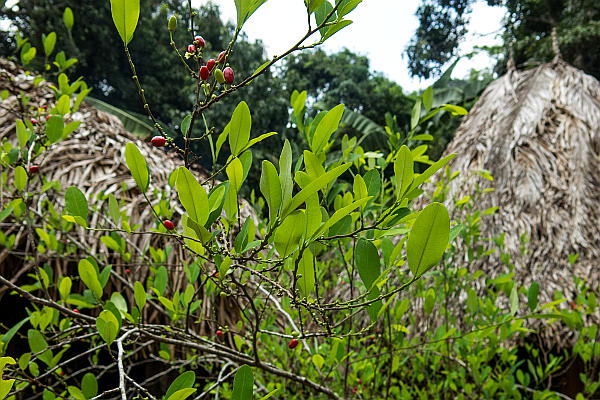
The Awá La Nutria Nature Reserve initiative, spearheaded by the Awá community of El Verde in Colombia, has strengthened community environmental governance through gatherings, interpretive tours, and the transmission of ancestral knowledge. Journalist Andrés Gómez tells the story in this article, created with a Nature-Based Responses to Biodiversity Loss Reporting Grant from the Latin American Solutions Journalism Fund, an initiative of El Colectivo 506. These grants were made possible by a donation from the Earth Journalism Network and its Biodiversity Media Initiative. The article was published by El Turbión on Nov. 16, 2025. It was adapted and translated here by El Colectivo 506 for co-publication. ChatGPT was used to create the first draft of the translation.
By: Andrés Gómez
The Chocó is a megadiverse bioregion with some of the highest levels of unique and migratory species in the world; it’s shared by Ecuador, Colombia, Costa Rica, and Panama. In Colombia, in the mountains along the Pacific coast of Nariño, the Awá Indigenous people live in this bioregion alongside hundreds of birds, plants, reptiles, amphibians, and mammals. The Awá have been victims of violence since colonial times, but especially because of the internal armed conflict and its war economies. In 2019, the Special Jurisdiction for Peace recognized the Katsa su—the great Awá territory—and the Awá people as victims of the Colombian armed conflict.
Barbacoas is one of the municipalities that forms part of the Chocó. It lies more than 1,000 kilometers (approximately 621 miles) from Bogotá in the foothills of the Pacific region of Nariño. It is one of Colombia’s largest municipalities, covering 5,090 square kilometers. Because it sits in one of the rainiest areas on Earth, it has a mountainous rainforest with some of the greatest biodiversity and water capacity on the planet. However, its rivers have been contaminated by oil spills, and its forests have been flooded with coca, poisoned with glyphosate, deforested, and polluted through the extraction of gold, copper, and silver since colonial times.
Today, the situation has worsened with the addition of zinc, platinum, and molybdenum mining, along with the extraction of clay, sand, stone, gravel, and crushed rock. According to the Truth Commission: “These activities are also linked to the presence of private companies and armed actors who take advantage of the lack of state protection to capture income from these activities or to carry out illegal mining.”
The control of all these revenue streams by illegal actors began in the early 2000s. Glyphosate spraying in Putumayo and Caquetá pushed coca crops into Nariño, where neither coca nor armed conflict had existed before. The Awá had already suffered racial discrimination, and some people turned to illegal economic activities such as the trade of animals and skins considered exotic; the logging of fine woods; cattle ranching; and gold mining. These activities not only damaged forests and jungles, but also disrupted their way of life.
The La Nutria and Monte Loro nature reserves are part of the Awá people’s responses to threats against the Katsa su—threats that also harm their lives and integrity as a people. These reserves are alternatives that allow them to heal the territory through their own knowledge, grounded in their relationship with the land and in their community organization, which continues to resist discrimination and violence.
“I started walking with the elders on the mountain trails”

We are reforesting cuángares (Dialyanthera gracilipes), guavos (Inga edulis), taras, huastas, and pulgandes (Carapa guianensis). Those are the common names we use here, the ones our ancestors taught us. They left us that legacy. …Those trees were heavily hit by logging … People cut them down to make a living because we are one of the most vulnerable areas, most abandoned by the state.
Euler García is part of the Monte Loro reserve. His words show how exclusion drove people to log fine woods to the point that, today, two species are in critical condition according to Corponariño: the cucharillo (Magnolia narinensis) and the chanul (Humiriastrum procerum), both razed for beams and fine furniture.
Through logging, people in Barbacoas earned some money, and at the same time they cleared pastures for cattle. However, cattle ranching was not profitable in the humid mountains, and they realized they were losing what they valued most—water.
Before, where we’re standing now was totally pasture. As time passed, we decided to conserve it because we were deforesting too much, we were polluting too much, and the water was disappearing. The water flow was extremely low. So the whole community decided, ‘We’re going to leave this area for conservation.’ And for the last 25 years, cattle ranching has been abandoned and conservation has begun.
These words from Miguel García, Euler’s brother, explain the motive for restoring the mountains. However, it is not an individual measure but a community response, as his brother explains:
We are nine partners, the owners of this conservation area—113 hectares. We’ve been seriously working on conservation for about six years, and working collectively with the nearby communities.
The urgency to recover the territory is not only the idea of those who sustain Monte Loro. La Nutria Reserve, located in the Gran Zábalo Resguardo, was also created as a strategy to protect the territory, biodiversity, and Awá spirituality.


Like Monte Loro, La Nutria combines passive restoration, agroecological restoration, community tourism, and facilities for birdwatching—tools that have become key for conservation. La Nutria also functions as an educational and spiritual space, with a “thinking center” where youth and elders gather to share knowledge, harmonize, and strengthen community unity.
Andrea Bisbicús is a second-semester biology student at the University of Nariño. She is 19 years old and began her process in La Nutria when she was seven. Today she conducts bird monitoring and observation walks as part of the reserve’s conservation and environmental education strategies, and she readily recognizes the work of intergenerational education:

I started walking with the elders on the mountain trails. […] They talked about conserving biodiversity, the territory, the Katsa su [the great house], and it caught my attention. I said, ‘I want to conserve our territory, to carry on the legacy of our elders.’ And thanks to that, I’m here in the reserve’s process, walking alongside the elders.
When asked about the bird monitoring she conducts, the importance of her team’s work is clear:
Here, with the team, we walk the routes to observe birds and to identify some species, especially those that are endangered, like the pava (Penelope perspicax) …The bird is large, black, with a red throat and white-like scales around the throat. You usually find it inside the forest, but because of hunting and logging, it has been disappearing.
The team that Andrea Bisbicús is a part of follows, observes and studies birds such as the guan. In the process, the team documents the lives of hundreds of species. According to Corponariño, in the Mira River basin alone, it is possible to find 741 bird species. The most numerous family is that of perching birds and songbirds, with 427 species, followed by hummingbirds and swifts, with 59 species, and then birds of prey, woodpeckers and toucans, with 27 species each.
This collective work in the La Nutria Reserve not only contributes to knowledge about biodiversity, but also strengthens what the armed conflict had fractured: the unity of the Awá people, the transmission of their knowledge, and the shared path between youth and elders.

On this point, Wilmer Bisbicús, 23, coordinator of the La Nutria Reserve, has no doubt that the reserve strengthens the Awá people, who have been declared at risk of physical and cultural extermination:
We’ve had more than 15 years of violence where we had to watch our leaders fall, and these social problems still continue. And it didn’t only affect the population… it also affected environmental rights: pollution, deforestation, and all of that also threatens the cultural and spiritual system, because this entire situation changed the mentality of the youth… The reserve has been a strategy for protecting and conserving the territory, and for the physical and cultural survival of the Awá people.
‘The chonta eventually bears fruit’

The Amazon is not the only tropical rainforest in Colombia. The Chocó Biogeographic Region stretches across Antioquia, Chocó, Risaralda, Cauca, Valle del Cauca, and Nariño. Its forests, like those of the Amazon, help regulate the planet’s climate by producing oxygen and capturing carbon, and they are also home to hundreds of unknown endemic species.
Racism against Indigenous peoples, lies about the forest, and the armed conflict have all worked against Indigenous knowledge and against understanding the species that inhabit these territories. Today, thanks to exchanges between Awá leaders and knowledge-keepers and academic researchers, the Awá people have not only expanded their knowledge—they have also shared it and continued building it as they document the consequences that the armed conflict has had on nature. This is reflected in the words of Ovidio Bisbicús when he talks about amphibians and reptiles, or herpetos:
Herpetos are also becoming endangered, like the kiki frog, the glass frog (Cochranella euknemos)… We have photographic records of the devil frog (Oophaga sylvatica), contaminated with crude oil.
The fate of the glass frog and the devil frog is similar to that of the harlequin toad and the Bolitoglossa walkeri salamander, a species without lungs that breathes through its skin. All are endemic amphibians of Colombia and face critical situations. According to Corponariño, in the Mira River basin alone, “28 percent of amphibian species were in threatened categories, with the highest number in the Vulnerable (VU) category, followed by Near Threatened (NT) and Endangered (EN).”
Through their reserves, the Awá people compile information about the damage in a systematic way. They also gather reflections on the adaptability of species affected by extractive economies that fueled indiscriminate logging. Andrea Bisbicús explains:
Despite the deforestation, they [the birds] adapt… thanks to conservation in the reserve, they have been able to recover.
In La Nutria, it is not only the birds that have returned. During nighttime walks, you can spot the glass frog, which, along with the devil frog, suffers from illegal trafficking, habitat loss and contamination. Both frogs are highly sensitive to pollution, and—like the birds—they have found a sanctuary in La Nutria Reserve.
A similar process is taking place in Monte Loro, where forest restoration has invited back the life that once inhabited the rainforest and has also improved water quality. But Miguel García says that despite these efforts, nothing ever returns to exactly what it was:
Birds that had dispersed to other territories are coming back, although not all the birds we once knew have returned. But some have come back… the peccaries, some cuzumbes (Nasuella olivacea), armadillos (Dasypus novemcinctus), guatines (Dasyprocta punctata), borugas (Cuniculus paca), and that has brought us great joy… Recently, you can see that the water is increasing. It will soon go back to what it once was, but because of the deforestation, the water course has changed permanently.
The Monte Loro Reserve, being higher above sea level than La Nutria, has different species. As the García brothers walk along the trails, they talk about how they have rediscovered fungi and insects through the experts and enthusiasts who visit them.


By recovering the forest through the reserves, they have been able to recover medicines and food that were affected by pipeline explosions and glyphosate fumigation. As Ovidio Bisbicús explains:
In every place or natural space, there is our own medicine with which we heal ourselves and find harmony. And this is the life of the Awá Indigenous communities… In some natural areas it had deteriorated, but since the pipeline [the Trans-Andean Pipeline] is not currently operating, the rivers and streams have been recovering, and we are recovering our medicines… Likewise, our own food has also been returning. Because of the fumigations, our staple crops were contaminated—corn, yuca, chiro (plantain), sugarcane—and they were greatly damaged, but we have begun to recover them.
Another aspect that has been strengthened through the reserves is language. Ovidio Bisbicús emphasizes that to communicate with the forest, it is necessary to speak awapit, the language in which the Awá have encoded the knowledge they have acquired over centuries—and a language that racism attempted to eliminate by humiliating and punishing those who spoke it. For him, through the language they speak with the Katsa su and reaffirm who they are:
And this is how, through permanent communication with nature, with the spirit of the forest, we also connect to listen to the songs of the birds, the different songs in the forest. You can also hear the wind, which harmonizes the clean air breathed by the reserve. Nature breathes for the rest of the Awá territory, for society in general… and in this sense, authorities, leaders and women leaders are awapit speakers… Education is helping ensure that our language remains over time, that our knowledge and understandings do not disappear.
Through the reserves, the Awá people have also chosen to strengthen their philosophical narratives about the role of human beings on Earth and within the community. For this reason, Wilmer Bisbicús does not hesitate to say that the actions of the resguardo and of the people who collaborate in the project follow the teachings of the chonta palm:
One of our philosophies speaks about the chonta. You need to have a firm root and grow straight like the chonta, and the chonta always seeks out the light. But you also must be straight in life and always look for that light: hope for the communities, and always bear fruit. The chonta eventually bears fruit.
Armed actors have destroyed our territory

Despite the efforts of those who are part of the reserves, the territory is still affected by customs that do not help restore the mountains. For that reason, Euler García believes more people need to get involved at the local level:
Some people don’t value what we are conserving. Some think that what we’re doing is work that has no future.
His brother Miguel García shares the same view, but adds that more support is needed:
Sometimes there’s no support to continue protecting, and without support it is hard to sustain the work.
Many of the tools they use, such as binoculars and equipment, have been self-financed. Although tourism brings in some income, it is very little to keep going. This is why support from institutions and from nature and conservation enthusiasts is needed.
However, poor land management practices are not the only threat to the Pacific region of Nariño.


The armed conflict and illegal coca, gold and oil economies are even more harmful. Ovidio Bisbicús recalls:
Armed actors have destroyed our territory… They have brought violence, conflicts, massacres, displacement, killings… Hydrocarbon contamination has been very serious… many rivers and streams… biodiversity that has been lost. There has been significant deforestation… to plant coca crops… and that has brought even greater environmental impacts.
The Trans-Andean Pipeline (OTA), which for years transported oil to the tanker ships at the port of Tumaco, was blown up several times by the former FARC-EP in actions against oil companies, and was perforated hundreds of times by dissident groups to extract crude and produce artisanal gasoline used in cocaine production.
Thanks to the advocacy efforts of the Awá people, the pipeline no longer transports crude. However, the threat of reopening remains, which could reactivate the cycle of contamination and violence that marked previous decades. If the OTA resumes operations, crude oil could once again be diverted to feed the cocaine laboratories that supply the global market—repeating a history that has already devastated rivers and streams.

Similarly, the suspension of aerial glyphosate spraying is only a temporary relief. One of the punishments endured by marginalized Indigenous communities—who turned to coca cultivation when the conflict reached them more than 20 years ago—was fumigation with this herbicide, a poison that did not eradicate coca but did sicken the forest.
Because fumigation depends on government decisions, it may return with future administrations, bringing airplanes once again to rain chemicals over crops, forests and communities.
Then there is the global threat of the climate crisis. Although the local contribution to global climate change is minimal, the consequences are not equal for everyone. Communities in Barbacoas have experienced major flooding, such as the Mira River overflow in 2009, and in the Patía and Sanquianga rivers in Olaya Herrera, the main concerns now center on floods, strong winds and landslides.
Walking together

In both reserves, Ovidio Bisbicús and brothers Euler and Miguel García proudly share their knowledge about orchids and lepantes—knowledge they have gained by advancing the reserves. Their example has pulled young Awá people into this process. As Ovidio Bisbicús explains:
Today young men and women, boys and girls have come very close. Environmental governance of the reserve is not only in the hands of adults, but the youth have become empowered in this environmental governance process.


Andrea Bisbicús is one of these young people. She reflects on how the reserve creates space for her participation as a young woman:
For me, being a woman is very important. And as a young woman, working here in the reserve… being part of the process has been very important because it has always been very marked that men participate in the work, in the workshops, in everything, and women end up very excluded.
The Monte Loro and La Nutria reserves show that ancestral knowledge and community organization can reverse the damage caused by centuries of racism and extractivism, and by decades of war. Where there were once pastures and contamination, today the forest grows back, the water clears and the animals return. And it is remarkable that restoration emerges from a deep conviction: caring for the forest is also caring for life and for the memory of the Awá people.
However, the threats posed by illegal economies, the armed conflict, institutional abandonment, and the effects of climate change continue to put pressure a territory that—despite its natural wealth and thousands of endemic species—remains one of the most impoverished and forgotten regions of Colombia.
In the face of this panorama, the Awá reserves are not only ecological refuges: they are also an ethical and political project that heals the territory from the roots, reaffirming that traditional knowledge, spirituality and science can walk together.
In the words of Euler García:
“The forest teaches. When you see a tree grow back, you learn that the land heals if you leave it in peace.”

In recognition of El Turbión’s commitment to integrity and excellence in journalism, the outlet has obtained the Certification of the Journalism Trust Initiative, promoted by Reporters Without Borders under the international standard CEN CWA 17493:2019.

Independent journalism and investigation are costly… Support us.