Hay que decirlo, la entrevista con Basil Farraj y Hashem Abushama nos dejó consternadas, y tal vez rabiosas, como dijo el poeta Benedetti. Farraj enseña en la Universidad de Birzeit, en Cisjordania, y estudia el encarcelamiento y las relaciones del Estado israelí con América Latina. Abushama es escritor y profesor de geografía humana en la Universidad de Oxford, e investiga el anticolonialismo, el marxismo y las formas de la solidaridad global. Los dos llegaron a la conversación después de una semana de espacios de discusión en Colombia durante el mes de septiembre, y hablaron desde su experiencia y desde lo que muchas comunidades han pensado y sistematizado durante décadas.
By Santiago Martínez and Andrés Gómez, Translated by: Clark Gudas
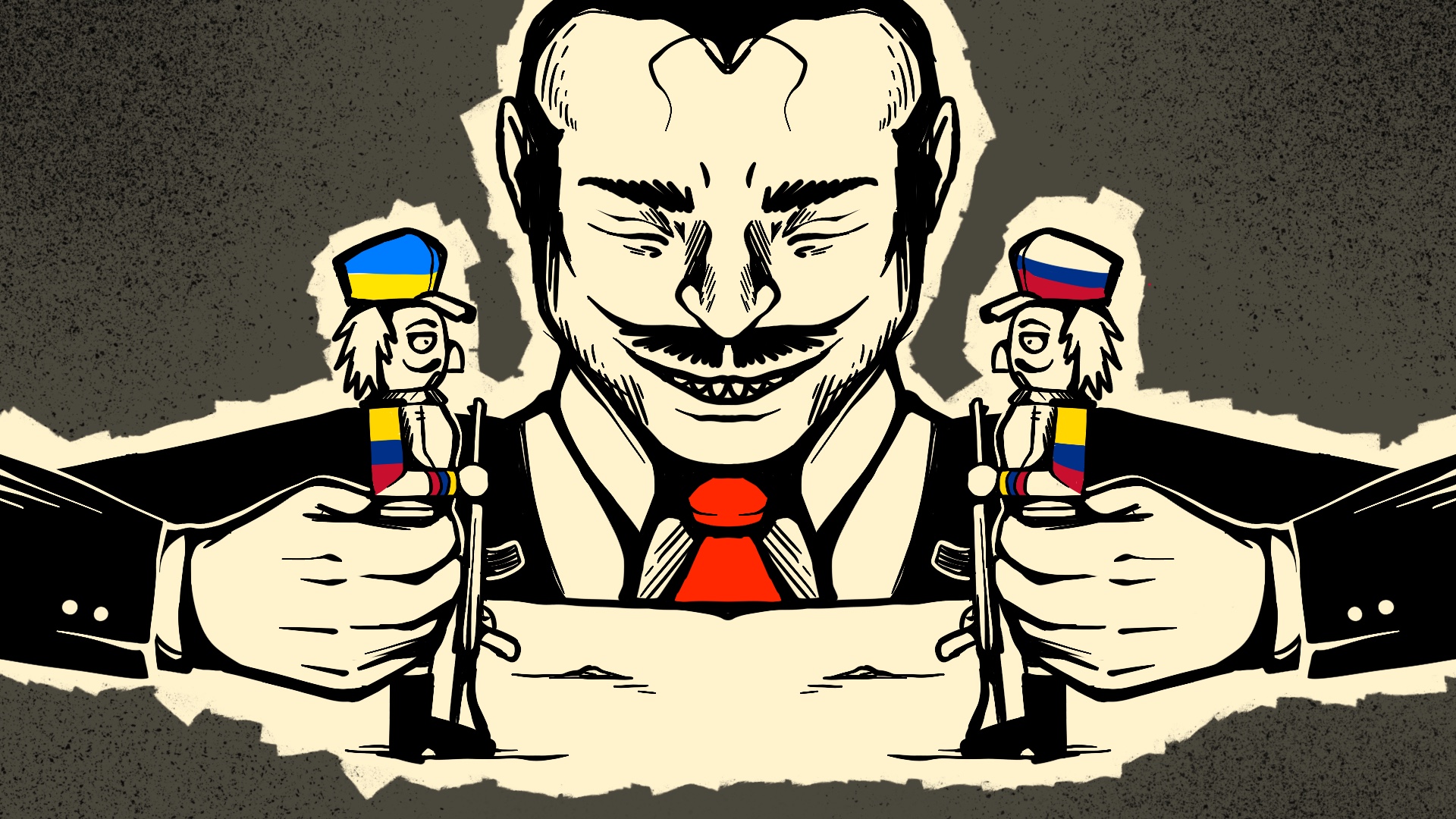
Ramiro* was driving to the bus terminal in Bogotá when, in the middle of a conversation, he mentioned that he wanted to go fight for Ukraine against Russia because he needed more money. Ramiro, a taxi driver, candidly confessed to his passengers that he wanted to participate in the international conflict. This kind of comment is not unheard of, and money was not his only motivation. While Ramiro spoke enthusiastically about the chance to make money, he also said, without shame, that if an acquaintance cheated him in a business deal, he would “settle the score” and then go off to war.
Beyond these motivations, whether to get rich or escape justice, there are always families that suffer for those who become mercenaries.
It seems selfish of them. Because the suffering, the anguish that we go through… not knowing if they’re okay, if they’re not, if something happened, there are no answers.
This is how Blanca Gómez describes what she feels about the disappearance of her spouse, Edgar Alonso Gómez, a man in his forties who was recruited by Russia in early 2026 while working in Poland in 2025.
Recruitment is no small matter, and there is no way to prevent it.
The radio program La Vaina, in episode 249, aired a program titled “The Colombians trapped in the Russian-Ukrainian War.” In it, Gladys Gaviria, mother of Jeiner Sánchez, a 21-year-old boy who died fighting under the Russian flag, said that nobody is stopping the recruitment, despite the death sentence it amounts to for many:
No one says anything. Because, look, when Jeiner fell, eight left our neighborhood Santo Domingo. Eight of them left, and all eight of them fell… from Aurora, from San Javier, they also went. Yeah, the working-class neighborhoods in Medellín, many left from our side, and we don’t know how many more there are.
Colombian soldiers, leveraging their years of training and combat in internal armed conflicts, with no other skills after retirement or discharge, don’t understand that when they become mercenaries, they turn into hitmen, accomplices to crimes against humanity, or cannon fodder in conflicts in Europe, Africa, and Latin America.
Colombian Mercenaries Around the World
Ilustration – Jalver Uyabán
In May 2026, then-president Gustavo Petro explained that, according to government estimates, there were 7,000 Colombian mercenaries abroad. Reports supported by organizations like the UN warn that the figure far exceeds 10,000 fighters.
What transnational agencies sell to these men as a simple job opportunity hides a dynamic where countries, or companies, exploit the economic vulnerability of Colombian ex-combatants, then order them to commit acts as extreme as assassinations, like that of President Jovenel Moïse in Haiti.
On July 7, 2021, 22 Colombians took part in the assassination of Jovenel Moïse and, besides money and jewelry, also took documents. According to investigations by the outlet El País, the Haitian president was about to hand over a “list of powerful politicians and businesspeople involved in drug trafficking.”
It it troubling that Abelardo De la Espriella has spoken out in favor of hitmen:
I have instructed the Ministers of Defense and Justice to provide legal assistance to the soldiers detained in the United States for their alleged participation in the assassination of the President of Haiti, as well as financial support to their families. The just must not pay for the sinners. I want to know exactly what happened and that each individual’s responsibility is clarified. I am not the kind of president to abandon his heroes when they face hardship. I won’t leave them alone: they will have our full backing to mount their defense and for this whole situation to be clarified.
By promising help and calling the mercenaries implicated in the assassination of Jovenel Moïse “heroes,” De la Espriella helps legitimize mercenarism from the presidency, downplays the assassination of the Haitian president, and normalizes violence committed by thousands of Colombians in foreign conflicts. And that violence is not insignificant.
Reports from Human Rights Watch have denounced companies from the United Arab Emirates for recruiting Colombians to join the paramilitary group Rapid Support Forces (RSF). Journalistic investigations reveal that in Colombia, the company A4SI promises between 2,600 to 3,400 dollars to join the organization.
According to Mona Rishmawi, member of the Independent International Fact-Finding Mission for the Sudan, “The RSF acted with intent to destroy, in whole or in part, the Zaghawa and Fur communities in El Fasher. These are typical elements of genocide.” This means that Colombian mercenaries who have been active in the carrying out of those objectives may be complicit in those crimes against humanity, in particular:
The extermination and persecution on ethnic, gender, and political grounds, as well as war crimes, including assassination, torture, rape, and other forms of sexual violence, violations of personal dignity, starvation, and attacks against civilian populations, against the wounded and sick, against those hors de combat, as well as against protected property.
Perhaps that is why Antonio*, a Colombian mercenary who was active in Sudan, did not want to continue participating in this investigation. Off the record, however, he made clear that he did not want to fight for Ukraine because of just how bloody the war is. Apparently, Antonio understood that the probability of surviving that conflict is low, and that the chances of one’s body disappearing are very high.
Jeiner Andrés Sánchez Gavíria, 21, traveled to Russia on May 10. He contacted his family only a few times after that, and nothing more was heard from him after June 21, when his brother called to inform them that Jeiner Sánchez had been “taken out” of combat, and that his body had been burned by an enemy drone.
Edgar Gómez’s situation is similar. He communicated for the final time on October 7 to say he had reported to the Russian army, mentioning that he belonged to “Unit 2, Battalion No. 3.” He has not called since.
He sent me photos in his uniform and a photo of his dog tag. It’s all I have, says Blanca.
Columbia’s Foreign Ministry, responding to a right of petition sent by this outlet regarding Colombians missing in the Russian-Ukrainian conflict, responded:
The Consular Section of the Colombian Embassy in Poland has a record of 384 cases of Colombian citizens reported as missing in action in the conflict between Ukraine and Russia, broken down as follows: 2022, no cases; 2023: 4 cases; 2024, 93 cases; 2025: 268 cases.
In the same response, the Foreign Ministry reported that the Russian Federation’s Ministry of Defense has reported “39 Colombian citizens” who, bound by contract to the Ministry of Defense, are “missing.” It also claims that it has received requests for assistance from relatives of nearly 100 Colombian citizens who were serving in the country’s army.
On September 9, 2026, the Foreign Ministry said it had received 863 requests for consular assistance from Ukraine and 890 from Russia. All of the relatives say they have lost contact with their loved ones, and the requests for assistance focus on the repatriation of remains, locating people declared missing in combat, and locating missing people whose families have no official confirmation.
Rules That Do Not Stop Mercenarism or Its Dangers
Ilustration – Jalver Uyabán
In Colombia, under Law 11 of 1992, a mercenary is considered someone who has been recruited, locally or abroad, to fight in an armed conflict, who is motivated by personal gain, and who has been promised, by or on behalf of a party to the conflict, material compensation considerably higher than that promised or paid to combatants of similar rank and function in the armed forces of their country of origin.
This legislation is a direct response to the crisis, because it establishes the crime of mercenarism, which now carries a prison sentence of 10-15 years, and also penalizes illicit recruitment with sentences of eight to twelve years.
With this instrument, the State finally establishes criminal procedural mechanisms that allow it to investigate those who finance or train these regular fighters. It also facilitates extradition by considering mercenarism as an offense covered by the international treaties in force, which strengthens the State’s jurisdiction to pursue those involved abroad.
Enforcement of the law, however, is hampered by a rigid evidentiary standard. For a person to be classified as a mercenary under criminal law, it must be proven that they were motivated exclusively by personal gain, or a considerably higher compensation.
This has created grey areas that allow the actors of privatized violence to evade justice by claiming they were providing advisory work. And, although the law presents a crucial step forward in treating recruiters and mercenaries as criminals, it does not resolve the problem. While Colombia continues to lack opportunities after military retirement, and worse, opportunities for former members of guerilla and paramilitary organizations, the promise of material reward will keep pushing thousands of Colombians to sidestep these legal barriers. This does not only represent a danger for the mercenaries and their families, but also to national and regional security.
In recent months, there has been an increase in reports related to the possible recruitment of criminal organizations in Mexico and Colombia. This situation has raised concerns that individuals with combat experience are receiving training in the use of drones and other military technologies. The hypothesis suggests that this lethal knowledge could be used to strengthen the capabilities of these organizations in Latin America, in struggles with the Public Security Force, civilians, for territorial control, dominance of strategic corridors and drug-trafficking routes.
The State’s response in terms of prevention, apparently, does not exist. El Turbión sent a petition to the Ministry of Defense asking about the prevention of recruitment of former members of the Public Security Force as mercenaries. The ministry merely acknowledged it received the message, and forwarded the matter several times: first to the Directorate of International Relations, then to the Directorate of Veterans and Rehabilitation, which in turn declared itself incapable of serving in this capacity, and forwarded the matter to the Directorate of Human Rights and International Human Law. None of the directorates responded to any of the questions.
There was no success either with the Attorney General’s Office, which affirmed that it has no “registerable information” about investigations into mercenarism or recruitment networks. When asked about the assassination of the Haitian president Jovenel Moïse, it forwarded the message to another office that never responded, and it flatly rejected to investigate what happened in Sudan, invoking the principle of territoriality, even though Colombian law allows for universal jurisdiction for genocide and crimes against humanity.
The Disappearance of Mercenaries Hits Their Families
Ilustration – Jalver Uyabán
Both the scarce material and social conditions for former combatants to build a life far from weaponry, and the lack of legal clarity, end up creating conditions in which thousands of people venture to work as hired killers in Mexican cartels, or Haiti, or participate in genocides in Sudan, or serve as cannon fodder for drones over Donetsk and Kharkiv. And although many are aware of the possibility of death, they don’t imagine that their bodies will probably disappear too, nor do they imagine the pain they cause their families.
When Jeiner Andrés Sánchez Gavíria decided to fight for Russia, he did not expect to be lied to about the money he would receive, much less about the repatriation of his body. His sister says he signed his contract right away for Russia:
In Bogotá, they gave them everything. They gave them clothing, changed their phones, they gave them everything, and the trip was excellent because everything was going well.. When they arrived there, they made them sign a contract in which… well, there’s nothing that… nothing we can ask for in terms of the repatriation of the body, or the money they promised him either. And there, the contract has a clause that says that it’s for one to five years, and they told him it was just one year…
According to Maritza, her brother Jeiner also didn’t think that the living conditions would be so difficult:
He told me in the first few days that he was okay. Then, after about 15 days, he told me it wasn’t so easy anymore. The drones. They had to fight against drones. They had to see dead bodies that had been thrown out in the open field, that they were kept, in, like, a prison, that they were mistreated, that they weren’t given food, that they were left enduring hunger and thirst.
Jeiner Andrés Sánchez Gavíria told his sister Maritza that he didn’t think he would come out alive:
June 9th was the last time that we spoke and the message was that they were going to put him on the front line, that I should pray for him… He told me that he knew he wasn’t going to leave alive.
His mother, Gladys Gómez, describes how, in the wake of his disappearance, all that she has left is the pain:
It’s anguish… I mean, if you’d had him, if you’d buried him, you’d say: ‘I buried him.’ But this way, it’s nothing, it’s more anguish, more pain.
The Russian Embassy only increases the uncertainty for the family of Edgar Alonso Gómez:
They told us in person that the person we were asking about did not appear among the dead, or the missing, or the wounded.
The disappearance is not an issue only for mercenaries recruited by Russia.
In Ukraine, Colombian bodies are disappeared by their own recruiters. Recently released testimonies of Ukrainian soldiers describe how they dispose of corpses of Colombian mercenaries using acid and fire. Former president Gustavo Petro had already warned of this degradation when he signed Law 2569 on March 17, 2026, denouncing how Colombian mercenaries are treated as an “inferior race” and used strictly as “cannon fodder.”
The gravity of the matter is intensified by journalistic investigations into intercepted emails about an alleged massacre of Colombians on the Ukrainian front, which brings to the forefront the macabre dilemma of whether we are witnessing crude war propaganda or the deliberate, silent extermination of mercenaries.
In the face of overwhelming numbers of the dead and missing, the institutional response has taken the form of different kinds of consular assistance.
Regarding Russian recruitment, the Foreign Ministry has put on its website the “Procedure for consular assistance in cases of Colombian citizens who have signed contracts for the provision of military services with the Ministry of Defense of the Russian Federation.” For Ukraine, El Turbión could only find an informative bulletin from 2024 that begins:
The Ministry of Foreign Affairs wishes to reiterate that the Government of Colombia does not promote nor facilitate the enlistment of Colombian citizens in the Ukrainian army. These kinds of personal decisions are entirely voluntary and individual.
In the case of Russia, while the Foreign Ministry’s procedure meets the need of families to take immediate action by submitting requests, emails, genetic samples, and documents, the reality is that it does not offer a material or concrete way to respond to their tragedies. In practice, its work is reduced to receiving formal communications and channeling diplomatic notes that remain entirely at the timing and goodwill of the Russian Federation’s Ministry of Defense.
The Irony of Carrying On in Wars
Ramiro left us at the bus terminal, trusting that, given his age of 46, the Ukrainian army would keep him in the rear. He barely listened to the reports that warned him of the danger, and that his job would possibly be to kill other Colombians. As I left the taxi, I could not stop thinking that it was very ironic that Ramiro deliberately ignored that he would kill other Colombians that were fighting for Russia, and how sad it would be that he knew nothing of the conflict he would participate in.
It is also worrying that the Colombians’ lack of information about the conflicts they take part in leads fellow citizens to participate in genocides in Sudan or in assassinations, like those in Haiti. It is equally alarming that cartels, dissident groups, and paramilitary organizations are increasing their military capacity with mercenaries who survive Donetsk and Luhansk.
Colombian mercenarism, without a doubt, ends up being useful for committing acts against international humanitarian law with absolute impunity. Until the precarious economic and pension conditions of the active reserve are addressed, and those of the thousands of former combatants have promised not to return to arms, and until it is accepted that every exported former combatant is a liability for global security, Colombia will continue to establish itself as a supplier of disposable criminal forces in contemporary wars.
In recognition of El Turbión’s commitment to integrity and excellence in journalism, the outlet has obtained the Certification of the Journalism Trust Initiative, promoted by Reporters Without Borders under the international standard CEN CWA 17493:2019.
Independent journalism and investigation are costly… Support us.
La sentencia en primera instancia contra el dirigente sindical y político brasilero José María de Almeida (Zé Maria), que está siendo apelada en este momento, marca un grave precedente sobre la libertad de expresión y la criminalización de la solidaridad con Palestina. En Colombia, el triunfo de Abelardo de la Espriella y su anuncio de restablecer relaciones con Israel aceleran la consolidación institucional de la definición IHRA que equipara las críticas a Israel con anti-semitismo.
La decisión del Consejo de Seguridad de la ONU de octubre ha provocado fuertes reacciones y ha sido interpretada como un paso hacia la anexión total del Sáhara Occidental por parte de Marruecos. Sin embargo, esa lectura es engañosa. El plan de autonomía marroquí que Estados Unidos ha impuesto en el Consejo de Seguridad, se basa en el anterior Plan de Paz de James Baker, en el que el derecho a la autodeterminación del pueblo saharaui sigue siendo un pilar fundamental.
En octubre 7 de 2025, las calles de Colombia se vistieron con la bandera de Palestina, en una jornada de movilizaciones en contra del Genocidio que ha perpetrado Israel desde hace 77 años y que se recrudeció en 2023, cuando Israel inició una supuesta ofensiva decisiva en la Franja de Gaza para aniquilar a los militantes de Hamás, pero que ha arrasado con la población palestina, desterrándola y vulnerándola ante los ojos de todo el mundo.
En Bogotá, desde la mañana se desarrollaron concentraciones en diversos puntos de la ciudad. Uno de éstos fue la embajada de los Estados Unidos, donde por más de 2 horas, una a una fueron llegando personas con banderas, pancartas y mensajes de respaldo a la comunidad Palestina. El objetivo: llegar a la Plaza de Bolívar alzando la voz en solidaridad con las víctimas del pueblo palestino y rechazar el genocidio en Gaza.
No es una guerra: es un genocidio
Foto: Andrea Umaña
Diversos sectores sociales hicieron presencia en las calles. María Flórez, docente y madre de familia, mientras caminaba junto a su hijo le comentaba a este medio:
Me movilizo por las madres de Palestina y las madres del mundo, hoy le enseñamos a nuestros hijos a ver la verdad de lo sucedido en Palestina, (…) para que vayan entendiendo, vayan comprendiendo que los actos de Israel contra el pueblo palestino son una barbarie, que hay que exigir y hay que apoyar así estemos en otro rincón del mundo.
José Cruz, del Frente de Acción por Palestina explica la responsabilidad directa del sionismo israelí y el imperialismo estadounidense con Benjamín Netanyahu y Donald Trump como figuras que deberían ser juzgadas por crímenes de lesa humanidad.
A nivel nacional e internacional estamos indignados por el genocidio que se ha venido cometiendo contra los y las palestinas, lo que está pasando en la Franja de Gaza, por parte del sionismo israelí y el imperialismo estadounidense (…)debemos exigir la captura y la condena de Benjamín Netanyahu y Donald Trump, son los genocidas.
Las más de 70 mil personas asesinadas y la hambruna causante de otras tantas muertes, refuerzan la gravedad de la situación, en la que la población palestina no tiene medios para defenderse ni acceso a alimentos, lo que agrava la crisis humanitaria. Ante este panorama, José hace un llamado:
Hay que defender la vida de Palestina, aquí en Colombia y en cualquier parte del mundo (…)invito a toda Colombia a que hagamos un acto de contrición y pensemos que la gran mayoría tenemos hijos, ¿nos gustaría que nuestros niños padecieran las cosas que está pasando la niñez palestina, que los están asesinando con balas y con hambre?
Una de las personas que atendió el llamado urgente a la movilización de una conciencia global que manifieste un compromiso como humanidad, es María, quien también convoca:
Todos debemos estar en movilización, todos tenemos que demostrar que realmente somos un pueblo del mundo. (…) debemos mostrar que son pocos los que tienen el poder, y por eso hay que salir a las movilizaciones, solo con nuestra fuerza, nuestro apoyo y nuestra solidaridad saca adelante al pueblo de Palestina.
Actos contra la humanidad
Solidaridad colombiana con Palestina – Video: Omar Vera
La ex ministra de Ambiente y Desarrollo Sostenible, Susana Muhamad, de ascendencia palestina, también estuvo en las calles denunciando la situación en la franja de Gaza. Para ella, en la actualidad se evidencia un desconocimiento absoluto del derecho internacional, así como la ausencia de institucionalidad mundial que ponga fin al genocidio.
Lo que está pasando es que una potencia respalda a un Estado genocida para hacer limpieza étnica de un pueblo, y lo hace con total impunidad. (…) Dos años viendo en vivo y en directo cómo hacen limpieza étnica al pueblo palestino y nadie hace nada, lo que muestra es que entonces cualquier pueblo del mundo puede estar sometido a lo mismo si no es una potencia militar (…) esto no es solamente inaceptable, sino que es contra la humanidad entera.
Ante sus declaraciones, es importante recordar que el 7 de octubre se cumplieron dos años del ataque de Hamas ante el intento de exterminio del pueblo palestino, por lo que Susana Muhamad llama a que la situación sea analizada y comprendida en toda su complejidad:
Producto de 80 años de ocupación y de 18 años de apartheid al pueblo de Gaza. (…) aquí no pueden venir a limpiar todo lo que han cometido, los crímenes de guerra que ha cometido el Estado de Israel con la reacción, que también es una reacción absolutamente violenta, de la población civil.
Una batalla global
Foto: Omar VeraFoto: Omar Vera
Al caer la tarde, algunas de las principales vías de Bogotá se conjugaban con la bandera ondeante de Palestina, y las calles fueron tomándose con las arengas de: “no es una guerra, es un genocidio” y “los niños en Gaza no son una amenaza” hasta llegar a la Plaza de Bolívar, donde se llevó a cabo una velatón de respaldo y apoyo.
Allí se encontraba Raouf Almalki, embajador de Palestina en Colombia, quien afirma que la solidaridad internacional no es un gesto secundario, sino una parte esencial de la lucha palestina. Para él, sin apoyo externo, esa lucha por el ejercicio de derechos fundamentales queda aislada y debilitada.
Palestina se está enfrentando no solo a un enemigo que es el sionismo, sino que también a unos enemigos globales. O sea, nuestra batalla es una batalla global. Así como están unidos los opresores, también los pueblos oprimidos, los pueblos que luchan por su libertad, por la justicia, por la paz, también tienen que estar unidos.
Palestina no puede avanzar sin una red de apoyo internacional que condene con acciones el genocidio en Gaza. Necesita expresiones de empatía, movilizaciones, presión política, boicots, difusión de información, entre otros. Sobre esto, Raouf Almalki es enfático:
Esta solidaridad se está trasladando en acciones, en presión a sus gobiernos para que esos gobiernos se muevan y empiecen a tomar medidas concretas en contra del Estado Genocida de Israel, para que cesa el genocidio y para que cesa la ocupación y la apartheid. Así como cayó la apartheid en Sudáfrica, también se tiene que caer en Palestina, gracias a la sociedad internacional, al boicot al Estado criminal de Israel y a las sanciones.
Las movilizaciones en el país, fueron la evidencia de cómo el pueblo colombiano no es indolente de la crisis humanitaria que se está viviendo en Palestina, y hoy celebra el cese al fuego pactado el 9 de octubre entre Israel y Hamas, aún cuando la voluntad de paz manifiesta por los sionistas es débil.
Tras el cese al fuego, la banda financiada por Israel perteneciente a la familia Doghmush, secuestró y asesinó al periodista Saleh Aljafarawi, quien había recibido amenazas del gobierno de Netanyahu y atentados del ejército israelí. El periodista cubría cómo la banda atacaba a desplazados palestinos que retornaban al barrio Al Sabra.
No está de más preguntarnos en qué panorama el genocida negocia con sus víctimas un alto al fuego, y hasta qué punto esto configura un interés genuino de paz. Según Muhammad Shehada, investigador del Consejo Europeo de Relaciones Exteriores, «Israel ahora busca provocar una guerra civil entre palestinos, a través de bandas criminales, algunas afiliadas a Daesh».
En reconocimiento al compromiso del equipo de El Turbión con la integridad y la excelencia en el periodismo, el medio ha obtenido la Certificación de la Iniciativa de Periodismo Confiable, promovida por Reporteros sin Fronteras con la norma internacional CEN CWA 17493:2019.
A principios de este año, en una inesperada divergencia de la retórica de política exterior predominante durante mucho tiempo en presidentes de ambos partidos, Donald Trump pronunció un discurso en Riad criticando a los intervencionistas, a los neoconservadores y el hábito de Estados Unidos de bombardear países de Oriente Medio: «Al final, los llamados ‘constructores de naciones’ destrozaron muchas más naciones de las que construyeron», dijo, «y los intervencionistas estaban interviniendo en sociedades complejas que ni siquiera ellos mismos entendían».
El pasado 27 de mayo, el presidente de la Argentina, Javier Milei, recibió en la Casa Rosada al secretario de Salud de Estados Unidos, Robert Kennedy Jr. Como resultado de esa reunión, Milei ratificó su decisión de retirarse de la Organización Mundial de la Salud (OMS) y se sumó a su propuesta de crear un organismo alternativo. Feliz con el encuentro, Kennedy Jr. escribió en su cuenta de Instagram que tuvo “una maravillosa reunión con el presidente argentino sobre el retiro mutuo de nuestras naciones de la OMS y la creación de un sistema de salud internacional alternativo basado en la ciencia de referencia y libre de impulsos totalitarios, corrupción y control político”.
En el Salvador solo se puede escuchar una voz: la de Bukele. En su megalomanía dictatorial se ha asegurado que nadie cuestione sus decisiones, ni investigue sus actos como mandatario, hasta el punto que hoy no se puede hacer prensa independiente en ese país. Sobre esta realidad, hablamos con Daniel Valencia y Óscar Orellana, dos periodistas que hoy toman medidas de autoprotección ante el miedo que impone el auto denominado “dictador más cool”, y quienes exponen cómo Bukele ha construido con tiranía la realidad de El Salvador, realidad que el globo parece ignorar y del que hacen eco autoritarios del mundo, a pesar de que seis de cada diez personas en El Salvador se autocensuran en redes sobre lo que opinan del déspota por temor a ser víctimas del régimen de excepción.
La expansión de las colonias menonitas en la Amazonía peruana ha desencadenado graves conflictos territoriales con las comunidades indígenas, cuyas formas de vida dependen del bosque tropical húmedo y su biodiversidad. Estas comunidades han habitado por miles de años estos territorios, desarrollando una relación con la naturaleza que garantiza tanto su subsistencia como su identidad cultural. Pero, la tala masiva y la conversión de bosques en tierras agrícolas por parte de los menonitas han generado un profundo impacto ambiental y social, vulnerando los derechos de los pueblos nativos, y poniendo en riesgo un ecosistema vital para amortiguar el cambio y la crisis climática.
Desde el 25 de abril del presente año, se encuentran en prisión injustamente dos dirigentes indígenas del año 2023, pertenecientes a la Organización Indígena ancestral denominada “Los 48 Cantones de Totonicapán” en Guatemala: Luis Pacheco, ex Presidente de los 48 Cantones y quien además funge como Vice Ministro de Energía y Minas; y , Héctor Chaclán, ex tesorero de la misma organización.
Estos hechos son parte de un entramado golpista que impulsa la Alianza Criminal que tiene cooptado el Sistema de Justicia en Guatemala y que busca defenestrar al presidente progresista Bernardo Arévalo.
Desde el 2017 se denomina como Pacto de Corruptos a una alianza criminal configurada para modificar el Código Penal y eliminar prisión para más de 400 delitos. Con esto, una de las oligarquías más rancia del Continente, militares genocidas del Conflicto Armado Interno, crimen organizado y funcionarios corruptos buscaban inmunidad e impunidad. A partir de ahí, este “Pacto de Corruptos” ha cooptado el poder del Estado para sus fines.
Vale recordar que, en las últimas elecciones presidenciales en el año 2023, la población dio una sorpresa al elegir al partido socialdemócrata: «Semilla» y al presidente Arévalo. Contra todo pronóstico, la ciudadanía no optó por las opciones de la derecha ni el continuismo de la corrupción.
Frente a esto, la Alianza Criminal de “El Pacto de Corruptos” inició un proceso golpista para evitar que se asumiera la nueva presidencia. Esto inició con el secuestro de los votos por el Ministerio Público, las acusaciones de fraude electoral y otras acciones que utilizaban de forma malintencionada diferentes argucias legales.
Frente a esto, autoridades y pueblos indígenas, lideradas por Luis Pacheco, presidente entonces de los “48 Cantones de Totonicapán” impulsaron un proceso de defensa de la Democracia, que duró 106 días, desde octubre de 2023 hasta el 15 de enero de 2024; y gracias al mismo, se respetó la decisión popular. Fue la resistencia del pueblo que garantizó la nueva presidencia.
El Gobierno de Arévalo ha vivido el asedio golpista, a partir de una guerra legal y mediática desde el Pacto de Corruptos. Ahora el Ministerio Público persigue penalmente a los principales líderes indígenas que impulsaron la gesta para la defensa del voto ciudadano y evitaron que los poderes corruptos desconocieran la voluntad del pueblo. Luis Pacheco y Héctor Chaclán fueron acusados de 5 delitos, que incluyó Terrorismo, Sedición, Asociación Ilícita, Obstaculización a la Justicia y Obstaculización a la Acción Penal.
La jueza Patricia Flores, también señalada por actos de corrupción, los ligó a proceso por dos delitos: Terrorismo y Obstaculización a la Acción Penal y los envió a prisión preventiva. Con esto se sienta un terrible precedente en Guatemala: ¡manifestar y defender derechos puede ser considerado como un acto de Terrorismo!
Además de la represión y criminalización, la justicia cooptada en Guatemala mostró un absoluto racismo, al desconocer la organización histórica de los pueblos originarios en el país y sus autoridades legítimas. Estos hechos ratifican que el Pacto de Corruptos abriga el colonialismo oligarca que se vincula en la actualidad con el narcotráfico y corrupción.
Las Autoridades Indígenas de diversos pueblos han hecho un frente común y en articulación con el Presidente Arévalo han realizado un llamado, el cual fue apoyado por el movimiento social, con el fin de demandar la inmediata libertad de Luis Pacheco y Héctor Chaclán; pero además, se unen para frenar todo un ataque orquestado a través de procesos legales y políticos en un nuevo intento golpista.
En prisión, Luis Pacheco y Héctor Chaclán esperan dos meses para la próxima audiencia intermedia. Se teme que el Pacto de Corruptos pueda manipular la justicia y entrampar el proceso, como ha sucedido con otros presos políticos. Además, el Ministerio Público persigue a otro líder indígena de esta gesta histórica, a Edgar Tuy, quien ahora es Gobernador de Sololá y señala 5 casos más.
Por estos motivos, Margaret Satterthwaite, relatora de la ONU sobre independencia judicial está de visita en Guatemala hasta el 23 de mayo. Resultado del movimiento social y popular, y cientos de ONG internacionales, incluyendo Human Rights Watch, que condenan estos hechos y demandan el debido proceso, y exigen el cese de la criminalización de las autoridades indígenas en Guatemala, porque defender la democracia no es un delito.