Ramiro* conducía hacia el terminal de transporte en Bogotá, y en medio de la conversación comentaba que quería irse a combatir por Ucrania contra Rusia por que necesitaba más dinero. Ramiro, conductor de taxi, de forma cándida confesaba a sus pasajeros que quería participar en un conflicto internacional. No es raro, y no solo lo motiva el dinero. Si bien Ramiro se entusiasmaba contando de la posibilidad de lucrarse, sin pudor también aseguraba que, si un conocido le quedaba mal con un negocio, lo “arreglaría”, y que luego se iría a la guerra.
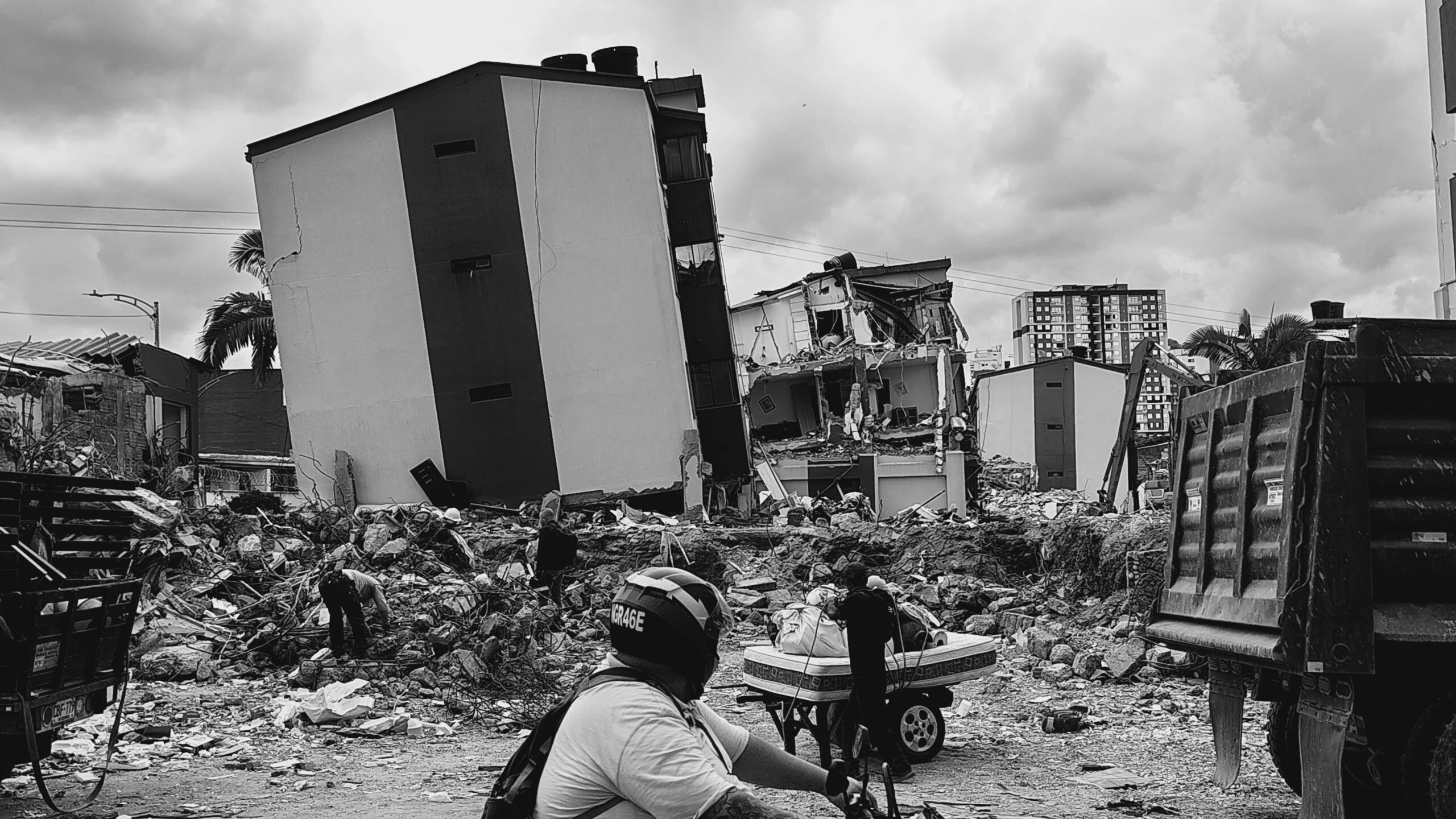
Pereira was one the cities hardest hit by the earthquake that struck Colombia on August 10. The quake left more than a hundred people dead or missing and thousands more displaced in the city. Today, those who lost their homes and can’t find another place to live are staying in temporary shelters or in parks, while unemployment has risen alongside rent prices.
Amid the precarity and uncertainty, networks of solidarity have sprung into action to help the earthquake’s victims. In search of collective and personal responses to the tragedy, El Turbión and CESJUL traveled to Pereira in mid-August with the support of Global Exchange. We found how dozens of people fed hundreds, distributed food packages, and used art to heal the trauma of a city that will need sustained support to rebuild.
Art That Heals
With “emergency pedagogy,” Aitar works through the trauma the earthquake has caused for dozens of children living in shelters in Pereira
The mayor’s office of Pereira reported 35,263 homes affected: 9,200 with structural damage, 10,124 with severe damage, in addition to 66 completely collapsed buildings, 34 health centers, and 165 schools. The sheer number of untenable homes and schools has resulted in hundreds of children living in shelters, where they are crowded together with their parents and other families. According to press estimates, 1,500 people went from living in an apartment or house to living in a tent within a shelter. This situation is already difficult enough for families, let alone when they have to share the space with hundreds of people.
Aware of the trauma left by the earthquake and these upheavals, Agitart has begun to volunteer in what’s called “emergency pedagogy” with children. We found them in the Parque del Oso en Pereira and observed how the organization, made up mostly of young women, created spaces for the children to express their emotions, with the goal of helping them through the crucial phase that follows any deeply traumatic event. They work to find tools within the children and their communities that support, heal, ad offer physically and emotionally safe environments.
We, like Agitart, are working so that children can grow up safer.
Agitart’s work isn’t easy. The people receiving state assistance are living in improvised shelters in the El Vergel Ecopark, Parque El Oso, Parque Olaya, the Balalcázar sports complex, and Plazoleta Risaralda. The Coliseo Mayor and the Mora Mora Stadium have already reached capacity, and Parque de la Libertad had to be evacuated because nearby buildings were at risk of collapse.
In the Face of Hunger, Solidarity
Las Weras preparing food The Intangible Museum preparing food
Hunger is real in Pereira and in the other hardest-hit cities. The UN World Food Programme (WFP) has requested 23 million dollars to provide three months of food assistance to more than 100,000 people affected across Colombia. Even so, the aid doesn’t reach everyone, least of all women who are heads of household. In addition, there are complaints about access to aid and a lack of transparency in how the aid is allocated.
Faced with this reality, the ecofeminist collective Las Weras, founded in the aftermath of the pandemic, has been cooking and distributing food to victims since August 10 with its “rebel pot.”
Las Weras preparing food packages for women heads of household affected by the earthquake
Today they are helping a hundred women, including pregnant and breastfeeding women, who lost their houses, family members, jobs or networks of care. While for now they are responding to victims by cooking and distributing food packages, Las Weras know of the new needs coming in the immediate future, which include psychological support, help finding work, the strengthening entrepreneurship for the women they serve, and the prevention of gender-based violence.
Another initiative feeding hundreds of people who are not in shelters but cannot cook or buy food is the community kitchen created by el Museo Intangible (The Intangible Museum) during the 2021 uprising, which the collective reactivated the very night of the earthquake. The Museum, together with Las Weras and other collectives, joined forces in the Parque Olaya for several days. Today, it operates in the Open House, a cultural collective in downtown Pereira that opened its doors to attend to the emergency.
The Intangible Museum has created a space of care through food at Open House
There they cook and distribute food to neighborhoods including San Nicolás, La Libertad, Corocito, Las Margaritas, Villa Santa Ana, and Villavicencio. Dozens of volunteers who turned up spontaneously prepare the food, but keeping the stove lit is difficult because aid diminishes every day. They also know that hunger and unemployment won’t change any time soon. As they put it:
People are hungry. They won’t have housing for a long time. They won’t have a job for a long time. The city isn’t going to be rebuilt this year.
Protecting the Animals
Mario Betancourt with his canine family
Mario Betancourt is a resident of Pereira, migrant who has returned from the United States, street vendor, and caretaker of five dogs he has rescued since 2021. He used to sell T-shirts, but he can’t anymore because many of the streets are still at risk of collapse. On top of that, the roof of his house caved in, and he is now among the displaced.
His daughters, as he calls his dogs, are called Celeste, Julieta, la Niña, la Negra, and Canela. All five are playful, their coats shining in the sun, alert to whatever Mario says as they run free in the park. Mario doesn’t know how to support his family of five rescued dogs, and the uncertainty weighs on him:
This is only the beginning. The economy has come to a halt and I live off what I sell in the street.
In response, he opened an Instagram account to sell his goods and keep caring for the family he chose to build.
Mario isn’t the only one struggling to support rescued animals. Ricardo Cardona is the owner of Cafe Bigotes, the first mission-driven cat café in Colombia’s coffee region, Eje Cafetero. It’s a cage-free place that, in its owners words, has rescued “more than 1,500 animals” and has found homes for 482 cats.
The earthquake took the café’s physical structure, but not its cats. Ricardo pulled nearly all of them from the rubble, and amid the aftershocks, only one cat is still missing; he leaves food out for her. Neighbors have spotted her while guarding their properties against looters looking for opportunity in the debris.
Ricardo Cardona, owner of Cafe Bigotes
Today Ricardo needs a house with space that’s comfortable for the cats, where he can set up his only source of income: a café. The money that Café Bigotes brings in is all that sustains his work with the animals. Ricardo Cardona in front of what remains of his Café Bigotes
Volunteering has its limits and costs for the people responding to this humanitarian emergency. Sustaining this work over time is only possible with solidarity and support from elsewhere. There is no reconstruction without solidarity for those providing support. Las Weras and the Intangible Museum are already doing their part to cook and provide food packages for hundreds of people. So is Agitart, in seeking to heal trauma through art, and so are Mario and Ricardo, in continuing to care for these animals they have chosen to protect.
The response from the city government and the department of Risaralda, and from Albelardo de la Espriella, have been denounced as insufficient and violent by several people we interviewed.
Violence as a Response to the Tragedy
In Pereira, the official statistics date from August 19 and come from the “Unified Command Post” of the mayor’s office. Since then, that data has stood as the official toll: 99 dead, 132 missing, and 259 injured. What’s certain is that we’ll never know how many people might have been saved or found. Abelardo de La Esriella’s decision to bar the entry of specialized search teams from countries not aligned with the far right delayed operations by three days, costing lives in every affected city. Adding to that incomprehensible decision was the cruelty of ordering the rubble cleared and the cities’ economies restarted less than a week after the disaster.
For those who lived through the earthquake, these decisions were emotionally devastating. They witnessed potentially injured people go unrescued, and instead, be treated like rubble after August 14. So says María Cristina López Bolívar, a professor at the Universidad Technológica de Pereira (UTP), who saw places – where everyone knew people and bodies lay buried – turn into empty lots overnight. What happened to the bodies?
De La Espriella failed to grasp that an earthquake leaves both individual and collective trauma, and starkly violated the right to rescue and to mourn. In other countries that have suffered similar disasters (Venezuela, for instance) rescue teams spent weeks unearthing cadavers so that they could be sent home, helping to close the wound for those affected families and for society as a whole.
Beyond that, thousands of people who depended on businesses located on destroyed properties or on the informal economy lost their livelihoods. Hunger and unemployment add to the uncertainty, and the response, once again, has been violent. It shows how displaced people will be treated. In Pereira, between September 2 and 3, 30 families displaced by the earthquake who had been eating from a communal pot were evicted by the Dialogue and Order Maintenance Unit (UNDMO), accused of invading public space.
This is a politics that places violence above life. While more than 367 of Colombia’s 1,100 municipalities wait for aid and support to begin rebuilding, Abelardo de La Espriella has revived a policy of aerial bombing that has already killed several children. He has walked among corpses reveling in his “iron first” campaign against criminal organizations.
With shelters in Pereira unable to take anyone else in, many people have ended up living on the streets in precarious conditions
Rebuilding the affected cities and towns is a social process that demands solidarity, memory, and justice. To rebuild is not to clear the rubble and raise buildings; rather to guarantee dignified mourning and respond with empathy to the people and their needs. Rebuilding is a matter of the highest importance for Colombia, and will only be possible if it’s built transparently, alongside the people affected, and obviously with a real commitment to the lives and the dignity of those who lost everything.
In recognition of El Turbión’s commitment to integrity and excellence in journalism, the outlet has obtained the Certification of the Journalism Trust Initiative, promoted by Reporters Without Borders under the international standard CEN CWA 17493:2019.
Independent journalism and investigation are costly… Support us.
La violencia performativa, es decir, ejecuciones sin juicio en el mar, oscurece la manera en que la administración está construyendo una nueva política de Estados Unidos hacia el hemisferio: actos de asesinato como herramienta para crear estructuras permanentes de dominación y extracción.
«El dominio estadounidense en el Hemisferio Occidental nunca volverá a cuestionarse», declaró el Departamento de Estado en un nuevo video que vincula, de manera algo improbable, la Doctrina Monroe de 1823 con el asesinato de personas en embarcaciones en el Caribe y el Pacífico, 200 años después.
Hacer estallar lanchas rápidas supuestamente para detener el contrabando de fentanilo, que cabe señalar, no llega a Estados Unidos en lanchas rápidas, parece carente de sentido. Como estrategia antinarcóticos es ineficaz, una valoración compartida por la DEA.
Plasmada en la Estrategia de Seguridad Nacional (NSS) de diciembre de 2025, la «Doctrina Donroe» busca restaurar la preeminencia estadounidense en una región que ha sido eclipsada por China, convertir reclamos de seguridad en autoridad militar excepcional contra los «narcoterroristas», institucionalizar esa autoridad mediante órdenes permanentes, «reclutar y ampliar» gobiernos alineados con Washington, y usarla para asegurar acceso estratégico y comercial. El fin deseado: cooperación militar, acuerdos comerciales, acceso a minerales críticos y tierras raras, probablemente acompañado de turbios tratos personales para la familia Trump. El retroceso democrático, en una región donde la democracia es aún relativamente joven, es una condición necesaria para su éxito.
La arquitectura de la Doctrina Donroe sigue en construcción. Los gobiernos latinoamericanos aún pueden resistir las presiones de Washington y negarse a co-crear su orden transaccional. Una mayor integración regional re-equilibraría ese poder de negociación, ayudando a los países con menos poder a imponer condiciones, defender límites constitucionales, rechazar operaciones particulares y soportar los costos de la presión estadounidense. Más de 100 legisladores, líderes políticos y expertos de 15 países se reúnen este fin de semana en el Tercer Congreso Panamericano en Montevideo para fortalecer la colaboración regional, la base de una arquitectura alternativa a una basada en el dominio estadounidense.
La resistencia a la coerción estadounidense, sin embargo, también depende de la reparación democrática dentro de la región. Los gobiernos capturados por líderes autoritarios no pueden proveer una base duradera para la soberanía. La corrupción erosiona la capacidad estatal y la confianza pública, haciendo más atractivas las soluciones militares extranjeras. La administración Trump apuesta por una doctrina hemisférica que favorece a líderes autoritarios, ávidos de participar en la corrupción.
La prueba de concepto más visible de la Doctrina Donroe comenzó con ataques aéreos contra embarcaciones frente a la costa de Venezuela, pasó por el asesinato de pescadores en el Pacífico, luego revelado como un programa encubierto de la CIA, y llegó al anuncio, en agosto, de una nueva Fuerza de Tarea Conjunta para el Hemisferio Occidental, que establece un cuartel general permanente para convertir esos asesinatos extrajudiciales en operaciones conjuntas con gobiernos aliados. Esto se corresponde con el Escudo de las Américas de la administración, una coalición de gobiernos latinoamericanos de derecha aliados con la administración Trump. Desde el secuestro del presidente de Venezuela, Nicolás Maduro, hasta los asesinatos por ataques a embarcaciones, todo se apoyó en dos guerras infinitas como marco y justificación que precedieron por mucho tiempo a Trump: la Guerra contra las Drogas y la Guerra contra el Terror.
Convertir a supuestos contrabandistas, muchos de ellos probablemente pescadores, en «narcoterroristas» es una forma de trasladar el tráfico del marco del derecho penal a las autoridades reclamadas en tiempo de guerra. Los sospechosos dejan de ser objeto de investigación para convertirse en blanco de ejecución inmediata, con evaluaciones secretas reemplazando el debido proceso y las pruebas en los tribunales. La urgencia de la seguridad nacional antepone la discrecionalidad del ejecutivo a la autoridad judicial. Los ataques a embarcaciones declaran públicamente la autoridad excepcional del ejecutivo. Los programas del Pentágono y la CIA la institucionalizan.
Como la Guerra contra el Terror, este encuadre retrata a un enemigo y crea una industria para gestionarlo. Crea sociedades de intercambio de favores con otros gobiernos que aprovechan la cooperación militar para obtener acceso a la asistencia extranjera estadounidense, armas, inteligencia y cobertura diplomática para fines poco decorosos, ya sea la represión interna, la corrupción o el asesinato estatal de su propia gente. Con las encuestas mostrando una confianza decreciente en todas las instituciones excepto en los militares, atizar el miedo a narcoterroristas todopoderosos sirve a los intereses mutuos de los reaccionarios en Washington, Bogotá y Tegucigalpa. El principal riesgo es que crea estructuras burocráticas que sobreviven a las administraciones de turno. Con la cooperación multilateral y las instituciones en declive, este nuevo complejo militar-industrial lo vuelve casi irreversible.
También crea herramientas para inmiscuirse en la política partidista interna. El éxito del «Escudo de las Américas» de Trump depende del giro continuo de América Latina hacia la derecha. Ecuador y Colombia ya aceptaron ataques militares «conjuntos» en su territorio, que probablemente se convertirán en ataques unilaterales estadounidenses. Trump intervino abiertamente en apoyo a la elección de Nasry Asfura en Honduras, como hace actualmente con Flávio Bolsonaro en Brasil. Que muchos de estos aliados estén ellos mismos vinculados al narcotráfico tiene poca importancia: el presidente de Colombia, de la Espriella, hizo carrera como abogado defensor de grandes narcos; al negocio frutero de la familia del presidente ecuatoriano Noboa se le halló transportando cocaína; y el expresidente de Honduras Juan Orlando Hernández obtuvo un indulto de Trump tras su condena en Estados Unidos por cargos de narcotráfico.
El proyecto funciona con mayor facilidad donde los cimientos democráticos son débiles y los líderes enfrentan menos restricciones por parte de los ciudadanos, los congresos, los tribunales y las instituciones independientes, lo cual refleja el propio esfuerzo de Trump por debilitar los frenos a la autoridad del ejecutivo dentro de Estados Unidos. Bukele en El Salvador ofrece el caso estelar del uso del espectro del crimen para consolidar un «estado de excepción» permanente y el autoritarismo. Tales regímenes pueden autorizar operaciones, compartir inteligencia, firmar acuerdos, asignar tierras y suprimir a la oposición con menos escrutinio.
El escrutinio democrático puede exponer los costos climáticos de la extracción, disputar las asignaciones de tierras y las intervenciones territoriales, exigir transparencia en los contratos e insistir en que la riqueza de los recursos beneficie al público. La corrupción evita esos controles al conectar al poder externo con porteros locales capaces de transferir recursos públicos y proteger el convenio. La falta de transparencia en torno a los más de 13.000 millones de dólares recaudados por Estados Unidos por la venta de petróleo venezolano ilustra la magnitud del problema de rendición de cuentas.
Para la región, el sistema emergente depende de que los gobiernos elijan participar y de que las instituciones sostengan su autoridad. Como progresistas en Estados Unidos, debemos desafiar las falsas afirmaciones antinarcóticos, el uso de fuerza letal sin control y el desperdicio de recursos públicos que sostienen este proyecto, y exigirle cuentas a nuestro gobierno. La resistencia regional y la reparación democrática deben avanzar juntas.
En reconocimiento al compromiso del equipo de El Turbión con la integridad y la excelencia en el periodismo, el medio ha obtenido la Certificación de la Iniciativa de Periodismo Confiable, promovida por Reporteros sin Fronteras con la norma internacional CEN CWA 17493:2019.
María del Rosario Chindoy had never heard of the mining concession FJT-141. Like many Kamëntsá women in Colombia’s Sibundoy Valley, she only realized something was changing when helicopters began flying over the mountains surrounding her territory. Seeking answers, the Women’s Council organized meetings and began asking local authorities what company was operating there. They found few answers. The copper mining project had been progressing for years without the communities’ knowledge; now the Council is trying to stop it.
For women, this is a grave threat because it destroys our territory and everything beneath our soil. As mothers on the council, our mission is to care for and protect this land.
Copper is essential to the energy transition, but demand is rising for its use in car manufacturing, which require three to four times more copper than gasoline-powered cars, as well as its use in the production of new weapons, and data centers. Combined with a lack of new mines and technical recycling challenges involved in recycling the mineral, this has caused market prices to soar, thereby increasing pressure on mining operations in regions such as the Colombian Amazon.
Libero Copper & Gold Corporation, a Canadian company that in 2025 changed its name to Copper Giant Resources Corp., plans to extract the red metal from the Amazonian department of Putumayo, exactly 10 km from Mocoa, the department’s capital, and in the surrounding mountains, but these mountains are no ordinary place.
The “Mocoa Project” is located in part of the Colombian Massif. This region of high biological richness encompasses the “Fluvial Star of Colombia,”a cluster of mountains between the departments of Cauca, Huila, Nariño, and Putumayo where five rivers originate: the Magdalena, Cauca, Caquetá, Putumayo, and Patía rivers. The Colombian Massif is also part of the “Andean Belt Biosphere Reserve,” an area recognized for its vital role in conserving biodiversity and regulating water. Functions that are essential to the biosphere reserves supported by UNESCO.
Frailejones are ‘water factories’ that channel water into the ground, giving rise to springs – Photo: Andrés Gómez
The copper mining project has been moving forward slowly for more than two decades in Putumayo, and although it has faced resistance in Mocoa, it has not met with the same reaction in the Upper Putumayo, despite two indigenous reserves overlapping with the mining titles: Condagua, the reserve of the Inga people, and the Kamentša Biyá reserve of the Kamentša people.
For members of the Kamëntšá Women’s Council, the problem has never been only the mine itself, but the lack of information surrounding it. They say municipal authorities, Indigenous authorities and the company have failed to explain how the project could affect their territory. That uncertainty has fueled mistrust and prompted the council to organize discussions, territorial walks and community meetings to understand what is happening.
The threat is the decline of our cultures, says council member María del Rosario Chindoy.
This is no small matter. In the mountains around the Sibundoy Valley, Libero Cobre operates in the so called FJT-141 mining block. This area is part of both indigenous reserves and forest reserve. The company also plans to work in its three other nearby mining blocks: FJT-131, FJT-132, and FJT-142.
The blocks overlap with many environmentally sensitive areas. These include the Upper Mocoa River Basin Forest Reserve, wetlands, the Remaining Natural Forests, Forests at Risk of Deforestation, the Doña Juana Complex páramos, Protected Forest Areas, and Water Protection Zones. They all serve as habitat for thousands of species, protect water and mitigate the impacts of climate change.
Mining Concessions in Times of War
Copper mining areas that overlap with the Yunguillo, Condagua and Kamëntša indigenous reserves, as well as forest reserve areas
The Sibundoy Valley sits among mountains in the Amazonian foothills. Former FARC-EP guerrillas used this area as a key route. This path connected southeastern Nariño to Lower Putumayo’s lowland rainforests. The Truth Commission (CEV) documented that the Inga and Kamëntša peoples suffered forced lockdowns, murders, armed combat, forced disappearances, and displacements in the Valley.
Amid the counterinsurgency war led by Álvaro Uribe Vélez(2002 – 2010), Anglo Gold Ashanti (AGA) acquired six mining concessions in 2004, which Mocoa Ventures Ltd. took over in 2009. During the Santos’ Mining Locomotive initiative, Mocoa Ventures carried out 12 drillings in the area, and in 2018 sold the concessions to the Canadian multinational Libero Cobre Ltd., which has since owned the mining titles: FJT-131, FJT-132, FJT-141, and FJT-142. The four titles cover 7,830 hectares and are located in the municipality of Mocoa, 10 kilometers from the city.
The concessions, however, were granted without consulting the communities in the Condagua and Kamëntšá Biyá reserves.
The Inter-American Commission on Human Rights has noted that the lack of prior consultation is one of the central factors in conflicts between extractive projects and Indigenous communities, especially when significant profits are at stake. And this is the case with Libero Cobre Ltd. a company which claims that the “Mocoa Project” has 232,000 tonnes of molybdenum and 2.1 million tonnes of copper:
Mocoa is home to one of the largest undeveloped copper-molybdenum deposits in the Americas, with significant additional exploration potential. The deposit remains open in multiple directions, and recent drilling has identified new high-grade zones.
At current market prices, the Mocoa project promoted by Libero Cobre represents a massive economic stake. The reported molybdenum reserves alone has a gross in-situ value of $14 billion. This estimate relies on benchmark prices of $50,000 to $60,000 per ton, as stated by the U.S. Geological Survey(USGS), in December 2025.
Following the ownership of the Mocoa Project is not straightforward. A 2023 review of corporate records shows that Libero Copper’s ownership structure extended beyond Canada and included companies incorporated in the British Virgin Islands under the control of the influential U.S. Sununu family:
Sununu’s politically connected, climate change-denying father, John H. Sununu, and brother, Michael Sununu, are more than just investors in Libero Copper & Gold. Michael is a board member of Libero, and he and his father sit on the board of the company’s largest shareholder, Anglo Asian Mining PLC, which operates in Azerbaijan.
A Mining Project Beyond Control
The presence of Libero Cobre raised concerns for the Mocoa City Council. In response, they approved Resolution 020 of December 6, 2018. This resolution prohibits medium- and large-scale mining in the municipality, but the National Mining Agency (ANM) challenged Resolution 020. The agency argued it did not follow the Constitutional Court’s Ruling SU-095 from 2018 that states that surface and subsoil are State property. However, Mocoa’s Administrative Courts denied the claim. The courts concluded that:
Municipalities may prohibit mining and energy activities within their territories in the exercise of their powers to protect the environment and regulate land use.
Despite the court’s ruling, Libero Cobre announced in October 2021 that exploration work had begun:
Boots on the ground exploration work at Mocoa has officially begun.
The company’s expansion also coincided with questions about its relationship with public institutions.
In 2021, Libero Copper not only began work without a permit, but also partnered with the Faculty of Mining at the National University of Medellín, with both parties signing an agreement to explore the deposit and train students, but Giovanny Franco, who served as Deputy Minister of Mines from October 2022 to 2 March 2023, was also a lecturer at the faculty and met with the company to promote the project whilst he was supposed to be overseeing it. Due to the obvious conflict of interest, Franco resigned following accusations from members of parliament and civil society organisations.
Commencing work without authorisation has led to a chain of unauthorised actions which, however, do not result in effective sanctions. In March 2022, Corpoamazonía inspected camps and drilling sites due to a breach of Mocoa Resolution 020. Theyfound that Libero Cobre hired Kluane, a Canadian firm, to handle drilling waste, but Libero Cobre had no records of the waste management process. They also discovered that Libero Cobre had cleared 5,000 square meters of land and built infrastructure without permits. Due to these issues, Corpoamazonía ruled that the company:
Cannot carry out any activity related to mineral exploration and exploitation within the jurisdiction of Mocoa …(and) must immediately suspend any activity it is currently conducting.
Yet documents obtained by El Turbión through freedom of information requests show that the National Mining Agency (ANM) itself later acknowledged Corpoamazonía’s warnings regarding “the possible development of activities” by Libero Cobre during suspension periods affecting the concessions FJT-131, FJT-132, FJT-141 and FJT-142.
The same documents reveal that, in the case of the FJT-141 concession, ANM inspectors “verified the presence of mining activities within the contract area” while the suspension remained in force. However, instead of sanctioning the company, the National Mining Agency accepted Libero Cobre’s request to lift the suspension, arguing that “the essential element of irresistible force majeure no longer existed.”
In late 2022, the Inga Council of Condagua filed a protection writ. They challenged the Ministry of the Interior and Libero Cobre. The council sought prior consultation on copper mining in Block FJT 131. While the Ministry of the Interior reviewed this petition, the Council of State annulled Agreement 020 in 2024. This judicial decision lifted the mining ban that the agreement had put in place.
Copper advances despite institutional gaps
After the annulment of Agreement 020 in 2024, Mocoa faced legal and territorial uncertainty. Meanwhile, Libero Copper moved forward with the Mocoa project. During that year, they launched a 14,000-meter drilling program and announced cadastral adjustments. According to the company, these changes removed overlaps with forest reserve areas. However, the adjustments announced by the company have not been verified by Corpoamazonía, which maintains that the concessions continue to affect protected areas.
But the same freedom of information documents reveal deeper institutional failures. The National Mining Agency (ANM) admitted that “no records of meetings with Corpoamazonía prior to the signing of the concession contracts” exist because “the ANM was not the mining authority” at the time. The agency also stated that determining whether Indigenous consultation was required “is the exclusive responsibility of the Ministry of the Interior.”
However, another official response obtained by El Turbión from the Ministry admitted that “no prior consultation processes” involving the Kamëntsá Biyá and Inga de Santiago peoples had been registered regarding mining projects in their territory. The authority only confirmed consultation-related processes involving the Condagua reserve and Libero Cobre’s FJT-141 concession.
In 2025, the Ministry of the Interior, the Mocoa Mayor’s Office, Corpoamazonía, and the National Mining Agency held 10 official sessions and 10 forums with the Inga de Condagua Council. On September 20, they finalized the agreements that allow the mining company to operate under the FJT 131 title, even though this area includes part of the Kamentša Biyá reserve.
The same year, the company intensified operations. The drilling pace increased, a second drill was deployed, and the project’s scope expanded. Results confirmed the deposit is a large-scale deposit, and the company announced that a third drill would be deployed by 2026.
Continuing violations
In the FJT 141 project, the moorlands (grey) and their buffer zone (green) would be seriously affected
Once again, the company is acting in violation of established regulations. Resolution DG No. 0631 of June 10, 2025, issued by Corpoamazonía, the FJT-141 concession currently in operation, along with the other three concessions in the construction and assembly phases, must suspend operations.
At the same time, the Ministry of Environment admitted that the process to integrate environmentally protected areas into the national mining cadastre “is still underway.” Meanwhile, according to the Mayor’s Office of Mocoa, the project area is classified in the municipality’s Land Use Plan as “Rural C – Absolute Protection Zone,” whose purpose is to “guarantee the permanence of water sources and the preservation of forest cover.” Yet the National Mining Agency (ANM) argued that “it is not the responsibility of the Mining Authority to carry out an analysis of territorial compatibility.”
Sandra Torres, a former Corpoamaazonía official, says Libero Cobre often escapes consequences. She blames this on negligence by public servants at the National Mining Agency.
Libero Cobre is drilling and operating despite its license being suspended by the National Mining Agency. The National Mining Agency was informed, but it turned a blind eye showing total indifference. This demonstrates repeated inaction.
Today, Libero Cobre continues to pursue its goal: to develop the project. The Sununu family seems to anticipate this could be a lucrative opportunity. The International Energy Agency says that the shift to new energy sources will increase copper demand by 50% by 2040.
Libero Cobre’s work proceeds without restriction due to state agencies’ failure to enforce the law. Yet, the State is aware of the potential damage this inaction may cause. The Environmental Licensing Agency (ANLA) recognizes that the villages of Campucana, San Antonio, Montclar, and Pueblo Viejo are located within Libero Cobre’s mining concession and near Condagua and Kamëntšá indigenous reserves.
ANLA also acknowledges that these communities “maintain cultural and practical ties to this area” and that the region “regulates water cycles” through fragile high-Andean and sub-Andean ecosystems. Yet despite these warnings, the project continues advancing in one of the territories most vulnerable to landslides, floods and climate disruption in the Colombian Amazon.
However, a council of Kamëntšá women is determined to stop the environmental damage.
Women in the Path of Libero Cobre
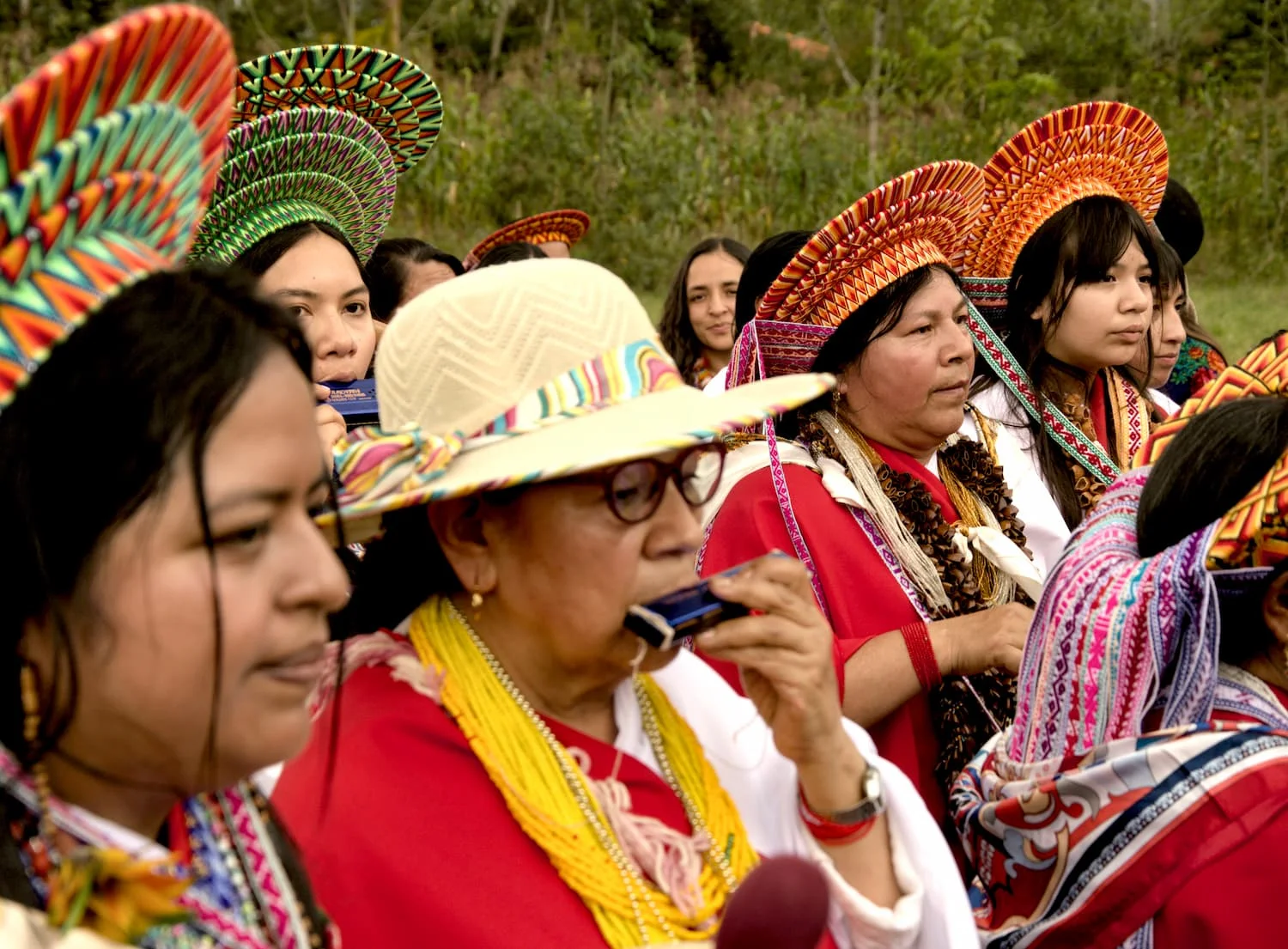
Mayra Alejandra Chindoy and María Chindoy, first and second from right to left during the Bëtsknaté – Photo: Andrés Gómez
When María del Rosario learnt of the copper mining taking place near her community, she and the Women’s Council organised a response and set up ‘circles of the word’ and ‘mingas’ for reflection and collective work. Both Kamëntšá and non-Kamëntšá people from the Valley came together to share their views. These participants began to question the mindset behind development and its promises.
Mayra Alejandra Chindoy, María del Rosario’s niece, says that as a result of these forums, they have come to understand how fleeting these promises are:
They say they can bring education, a bridge, stores, or new jobs. But that’s only temporary, Mayra explained.
Twelve women lead the council. By urging others to care for the environment, they have become a strong feminine force within their reservation.
We feel very satisfied. Bringing together 200, 300, or even 400 women is a real achievement.” We invited the elders to share, and many responded, “That’s interesting, keep going, we’ll join you too.” Their support has been a great source of strength for us. They’re with us; we can count on them.
Many of the Councilwomen’s activities have centered on Libero Cobre (now Copper Giant). El Turbión first learned of their concerns regarding the mining company through our partner, Fundación Bitácora Ciudadana . This organization met with the Councilwomen and shared the group’s story with us to ensure their voices were heard.
Despite their interest, these women did not know that mining blocks FJT 141 and part of FJT 131 were on their territory. They were also unaware of other blocks or that the neighboring Condagua Reservation had yielded to the company’s demands for the FJT 131 block in 2025.The Kamentsá women noticed Copper Giant’s presence when helicopters began flying over their mountains.
Unsure of what was happening, they decided to visit the nearest moorland, and El Turbión accompanied them. The plan was to walk through the territory, share knowledge across generations while gathering edible plants and medicinal herbs, and discuss the company’s local impact. As we climbed into the páramo, another threat became evident—one that goes beyond mining: the effects of the climate crisis.
Women who support the conservation of the páramos – Photo: Andrés Gómez
The Upper Putumayo is one of the rainiest places on Earth, but its waters are already changing. This páramo ecosystem depends on the frailejones, plants endemic to Colombia, Ecuador and Venezuela, which grow just one centimetre a year. These delicate plants absorb moisture from the mist and act as water factories by channelling water into the ground, feeding springs and water sources that nourish the streams flowing into the River Mocoa, part of the Caquetá River basin which flows through the Amazon.
Eight years ago, we used to walk on a watery cushion, and we’d end up completely soaked!” But look at it today, with the few days of summer we’ve had, and the ground is dry. Well, yes, there are small patches that still have a little mud, but that’s about it. Before, we would get completely soaked.
Luisa Chindoy’s words, spoken in the forest among the frailejones, reveal her fear that the páramo will degrade, and that Libero Cobre will intensify that degradation.
But environmental change is not the only concern. Libero Cobre has sought to shape local perceptions through cultural events and symbolic gestures. Miguel, a young indigenous guard, explained that the multinational co-opts the community’s events and sacred dates for its own promotion. This includes the «Clestrinye,» a celebration that is part of the day known as the Bëtsknaté: Great Day or Day of Forgiveness, shared by the Kamentsá and Ingas.
And what hurts me the most about this multinational is that a year ago, on the eve of ‘Clestrinye,’ they went around giving away drums to anyone who wanted one, but with the Libero Cobre logo on them. So it’s like they’re gradually making it clear—in quotes—that it’s good, that it’s going to bring development, but development only for the moment.
Bëtsknaté (first from right to left) – Photo: Andrés Gómez
“Green transition” at the risk of a catastrophe?
Libero Cobre activities do not seem consistent with a company focused on a clean and sustainable energy transition. Its dealings with indigenous communities have been opaque and disregard the regulations of environmental agencies. Whilst the mining company owned by the Sunnunu family had initially planned an open-pit mine, now, it insists it can conduct underground mining with less environmental impact. But underground mining still has major safety risks in the Andean-Amazonian foothills of Putumayo. The Mocoa River basin is known for its powerful torrents and steep, deep canyons. Sandra Rodríguez, a geologist and former Corpoamazonía contractor, confirms this assessment.
The water source there is young, and furthermore, it is still dynamic and has great force. The narrow canyon increases its speed and power.
Sandra Rodríguez is not exaggerating. Data from the Institute of Hydrology, Meteorology, and Environmental Studies and the Colombian Geological Service, as cited by Corpoamazonía, show that 80% of Mocoa faces a high or very high risk of landslides, flash floods, and floodings. Since 1998, Mocoa has recorded over 80 disasters. Most of these disasters are linked to geomorphological and hydrological processes.
The underground exploration and mining proposed by Libero Copper could make this situation worse.
Corpoamazonía says mining concessions for the “Mocoa Project” are in areas prone to mass movements. These risks exist alongside flash floods from heavy rains that trigger mudslides and sediment runoff. Both types of disasters have happened several times in the region. Sandra Rodríguez fears Libero Cobre’s operations will harm local communities and believes this damage has already begun.
There have already been events that occurred last year on this little stream that affected Pueblo Viejo here. They destroyed a bridge that connects Montclar, San Antonio, and Pueblo Viejo. A small amount of mud was enough to destroy this bridge. I can’t even imagine what it would be like with more rocks and sediment falling into the stream.
The danger is not limited to the communities threatened by rockslides and mudslides. Copper miners also face the threat of mine collapse. Sandra Rodríguez explains:
I would even go so far as to say that 70% to 80% of all accidents inside the mine are due to collapses. Consider the Marmato case in Caldas, where collapses happen constantly. The key difference is that Marmato is located in a forest area that is almost dry. The rainfall there is less than 10% of what we get here in this Amazonian region. Yet collapses still occur frequently.
A transition that demands a State that cares
Woman hands caring – Photo: Andrés Gómez
The energy transition is advancing, but without effective technologies to recycle electronic waste, the demand for copper will continue pushing mining deeper into territories such as Putumayo. In Mocoa, this does not only mean extracting a mineral. It means intervening in páramos, forests and water systems that sustain Indigenous communities and regulate life across the Andean-Amazonian foothills.
The Kamëntsá women know this well. In response, not only they organize mingas, discussions and territorial walks. They collect seeds, monitor springs and try to defend the territory before the damage becomes irreversible. Their actions also reveal something deeper than opposition to mining.
In a region torn apart by war, displacement and institutional opacity, the Women’s Council is striving to uphold collective forms of territorial stewardship and communal decision-making that the State has never guaranteed. Whilst the authorities have fragmented responsibility amongst the agencies responsible for mining, the environment and prior consultation, the women are organising themselves to learn about the issue, holding assemblies to share what they have learnt, walking the páramo and bringing together elders and young people to discuss what is at stake.
Elderly people who cherish their culture and the way of life rooted in the páramo, now under threat from the copper mining project – Photos: Andrés Gómez
The conflict is not just about the copper deposits beneath the mountains, but about who has the authority to determine the future of the territory itself. And on this point, Rosario Chindoy calls on her people to be prudent:
Money comes, as the saying goes, but money runs out and the fool is left behind. What good is it to us if our authorities bring in vast amounts of money? Resources and programmes may arrive, but if we are losing our essence, if we are not thinking like Kamëntšá, if we are not feeling like Kamëntšá… then what use is the money?
* El Turbión submitted a formal request for information to Copper Giant Resources Corp. (formerly Libero Copper), enquiring about the overlap of its mining concessions with indigenous reserves and forest reserves, as well as its failure to comply with a suspension order issued by Corpoamazonía; however, the company never replied.
In recognition of El Turbión’s commitment to integrity and excellence in journalism, the outlet has obtained the Certification of the Journalism Trust Initiative, promoted by Reporters Without Borders under the international standard CEN CWA 17493:2019.
Independent journalism and investigation are costly… Support us.
María del Rosario Chindoy nunca había oído hablar de la concesión minera de cobre FJT-141. Como muchas mujeres Kamëntšá del Valle de Sibundoy, en Putumayo, Colombia, solo se dio cuenta de que algo estaba cambiando cuando helicópteros comenzaron a sobrevolar las montañas que rodean su territorio. En busca de respuestas, el Consejo de Mujeres Kamëntšá organizó reuniones y preguntó a las autoridades locales qué empresa operaba allí. Encontraron pocas respuestas. El proyecto minero de cobre había avanzado durante años sin que las comunidades lo supieran, ahora el Consejo intenta detenerlo.
“Para nosotras, las mujeres, esto es una amenaza grave porque destruye nuestro territorio y todo lo que hay bajo nuestra tierra. Como madres en el Consejo, nuestra misión es cuidar y proteger esta tierra”, afirma María del Rosario.
El cobre es esencial para la transición energética, su demanda está aumentando para la fabricación de automóviles eléctricos que requieren de tres a cuatro veces más cobre que uno a gasolina, además del uso del cobre en la producción de nuevas armas y centros de datos. Esta situación, sumada a la falta de nuevas minas y a los desafíos técnicos del reciclaje del mineral, ha provocado que los precios del mercado se disparen, lo que incrementa la presión minera en regiones como la Amazonía colombiana.
Libero Copper & Gold Corporation, una empresa canadiense que en 2025 cambió su nombre a Copper Giant Resources Corp., planea extraer el metal rojo del departamento amazónico de Putumayo, exactamente a 10 km de Mocoa, la capital del departamento, y en las montañas circundantes, pero estas montañas no son un lugar cualquiera.
El «Proyecto Mocoa» se encuentra en una parte del Macizo Colombiano. Esta región de alta riqueza biológica abarca la «Estrella Fluvial de Colombia», un conjunto de montañas entre los departamentos de Cauca, Huila, Nariño y Putumayo donde nacen cinco ríos: el Magdalena, Cauca, Caquetá, Putumayo y Patía. El Macizo Colombiano también forma parte de la «Reserva de la Biosfera Cinturón Andino«, un área reconocida por su papel vital en la conservación de la biodiversidad y la regulación del agua, funciones esenciales para las reservas de la biosfera respaldadas por la Unesco.
Los frailejones son «fábricas de agua» que canalizan el agua hacia el suelo, dando origen a manantiales – Foto: Andrés Gómez
El proyecto minero de cobre en Putumayo ha avanzado lentamente durante más de dos décadas, y aunque ha enfrentado resistencia en Mocoa, no ha tenido la misma reacción en el Alto Putumayo, a pesar de que dos resguardos indígenas se superponen con los títulos mineros: Condagua, en el resguardo del pueblo Inga, y el resguardo Kamëntšá Biyá del pueblo Kamëntšá.
Para las integrantes del Consejo de Mujeres Kamëntšá, el problema no ha sido solo la mina, sino la falta de información que la rodea. Afirman que las autoridades municipales, las autoridades indígenas y la empresa no han explicado cómo el proyecto podría afectar su territorio. Esa incertidumbre ha alimentado la desconfianza y ha llevado al Consejo a organizar discusiones, caminatas territoriales y reuniones comunitarias para comprender lo que está sucediendo.
“La amenaza es la decadencia de nuestras culturas”, afirma la consejera María del Rosario Chindoy.
El proyecto minero no es poca cosa. En las montañas que rodean el Valle de Sibundoy, Libero Copper opera en el denominado bloque FJT-141. Esta área forma parte tanto de los resguardos indígenas como de la reserva forestal. La empresa también planea trabajar en sus otros tres bloques mineros cercanos: FJT-131, FJT-132 y FJT-142.
Los bloques se superponen con áreas ambientalmente sensibles, como la Reserva forestal de la cuenca alta del río Mocoa, humedales, los bosques naturales remanentes, bosques en riesgo de deforestación, los páramos del complejo Doña Juana, áreas forestales protegidas y zonas de protección de aguas. Todas ellas sirven como hábitat para miles de especies, protegen el agua y mitigan los impactos del cambio climático.
Concesiones mineras en tiempos de guerra
Zonas de extracción de cobre que se superponen con las reservas indígenas de Yunguillo, Condagua y Kamëntša, así como con zonas de reservas forestales
El Valle de Sibundoy se encuentra entre montañas en el piedemonte amazónico. Las antiguas guerrillas de las FARC-EP utilizaron esta zona como una ruta clave. Este camino conecta el sureste de Nariño con las selvas tropicales del Bajo Putumayo. La Comisión de la Verdad (CEV) documentó que los pueblos Inga y Kamëntšá sufrieron confinamientos forzados, asesinatos, combates armados, desapariciones forzadas y desplazamientos.
En medio de la guerra contrainsurgente liderada por Álvaro Uribe Vélez (2002 – 2010), la entonces multinacional sudafricana Anglo Gold Ashanti (AGA), adquirió seis concesiones mineras en 2004, que Mocoa Ventures Ltd. asumió en 2009. Durante la iniciativa de la Locomotora Minera del gobierno de Santos, Mocoa Ventures realizó 12 perforaciones en la zona y, en 2018, vendió las concesiones a la multinacional canadiense Libero Copper Ltd., que desde entonces es propietaria de los títulos mineros: FJT-131, FJT-132, FJT-141 y FJT-142. Los cuatro títulos abarcan 7.830 hectáreas y se encuentran en el municipio de Mocoa, a 10 kilómetros de la ciudad.
Las concesiones se otorgaron sin consultar a las comunidades de los resguardos Condagua y Kamëntšá Biyá.
La Comisión Interamericana de Derechos Humanos ha señalado que la falta de consulta previa es uno de los factores centrales en los conflictos entre proyectos extractivos y comunidades indígenas, especialmente cuando hay importantes ganancias en juego. Y este es el caso de Libero Copper con el «Proyecto Mocoa»:
Mocoa alberga uno de los depósitos de cobre-molibdeno sin desarrollar más grandes de las Américas, con un potencial de exploración adicional significativo. El depósito permanece abierto en múltiples direcciones, y las perforaciones recientes han identificado nuevas zonas de alta calidad.
Infografía: Jalver Uyaban
Seguir la propiedad del Proyecto Mocoa no es sencillo. Pero una revisión de los registros corporativos de 2023 muestra que la estructura de propiedad de Libero Copper se extiende más allá de Canadá e incluye empresas constituidas en las Islas Vírgenes Británicas bajo el control de la influyente familia estadounidense Sununu:
El padre de Sununu: John H. Sununu, con conexiones políticas y negacionista del cambio climático, y su hermano, Michael Sununu, son más que simples inversores en Libero Copper & Gold. Michael es miembro de la junta directiva de Libero, y él y su padre forman parte de la junta del mayor accionista de la empresa, Anglo Asian Mining PLC, que opera en Azerbaiyán.
Infografía: Jalver Uyaban
Un proyecto minero fuera de control
La presencia de Libero Copper generó preocupación en el Concejo Municipal de Mocoa. En respuesta, aprobaron la Resolución 020 del 6 de diciembre de 2018. Esta resolución prohíbe la minería mediana y gran escala en el municipio, pero la Agencia Nacional de Minería (ANM) impugnó la Resolución 020, y a través de la Sentencia SU-095 de 2018 de la Corte Constitucional, argumentó que la superficie y el subsuelo son propiedad del Estado. Sin embargo, los Tribunales Administrativos de Mocoa negaron la demanda concluyendo que:
Los municipios pueden prohibir las actividades mineras y energéticas dentro de sus territorios en ejercicio de sus facultades para proteger el medio ambiente y regular el uso del suelo.
A pesar del fallo judicial, Libero Copper anunció en octubre de 2021 que los trabajos de exploración habían comenzado:
Con las botas en el terreno, el trabajo de exploración en Mocoa ha comenzado oficialmente.
En 2021, Libero Copper no solo empezó trabajos sin permiso, también se asoció con la Facultad de Minas de la Universidad Nacional de Medellín y ambas partes firmaron un acuerdo para investigar el depósito y formar a estudiantes, pero Giovanny Franco, quien fue el viceministro de Minas de octubre 2022 al 2 de marzo de 2023, también era profesor de la facultad y se reunió con la empresa para promover el proyecto mientras se suponía que debía supervisarlo. Por el obvio conflicto de intereses, Franco renunció tras acusaciones de congresistas y organizaciones sociales.
Empezar trabajos sin autorización ha ocasionado una cadena de acciones no permitidas que, sin embargo, no resultan en sanciones efectivas. En marzo de 2022, Corpoamazonía inspeccionó los campamentos y sitios de perforación debido al incumplimiento de la Resolución 020 de Mocoa. Descubrieron que Libero Copper contrató a Kluane, una empresa canadiense, para manejar los residuos de perforación, pero Libero Copper no tenía registros del proceso de gestión de residuos. También descubrieron que Libero Copper había despejado 5.000 metros cuadrados de tierra y construido infraestructura sin permisos. Debido a estos problemas, Corpoamazonía dictaminó que la empresa:
No puede realizar ninguna actividad relacionada con la exploración y explotación de minerales dentro de la jurisdicción de Mocoa… (y) debe suspender inmediatamente cualquier actividad que esté realizando actualmente.
Sin embargo, documentos obtenidos por El Turbión a través de solicitudes de libertad de información muestran que la propia Agencia Nacional de Minería (ANM) reconoció posteriormente las advertencias de Corpoamazonía sobre «el posible desarrollo de actividades» por parte de Libero Copper durante los períodos de suspensión que afectaban a las concesiones FJT-131, FJT-132, FJT-141 y FJT-142.
Los mismos documentos revelan que, en el caso de la concesión FJT-141, los inspectores de la ANM «verificaron la presencia de actividades mineras dentro del área del contrato» mientras la suspensión seguía vigente. Sin embargo, en lugar de sancionar a la empresa, la ANM aceptó la solicitud de Libero Cobre de levantar la suspensión, argumentando que «el elemento esencial de fuerza mayor irresistible ya no existía».
A finales de 2022, el Cabildo Inga de Condagua presentó una acción de tutela. Impugnaron al Ministerio del Interior y a Libero Copper. El cabildo solicitaba la consulta previa sobre la minería de cobre en el Bloque FJT 131. Mientras el Ministerio del Interior revisaba esta petición, el Consejo de Estado anuló el Acuerdo 020 en 2024. Esta decisión judicial levantó la prohibición minera que el acuerdo había establecido.
El cobre avanza pese a las brechas institucionales
Tras la anulación del Acuerdo 020 en 2024, Mocoa enfrentó incertidumbre legal y territorial. Mientras tanto, Libero Copper avanzó con el proyecto Mocoa. Durante ese año, lanzaron un programa de perforación de 14.000 metros y anunciaron ajustes catastrales. Según la empresa, estos cambios eliminaron las superposiciones con áreas de reserva forestal. Sin embargo, los ajustes anunciados por la empresa no han sido verificados por Corpoamazonía, que insiste en que las concesiones siguen afectando zonas de protección.
Plano que muestra los límites del bosque de protección regional en relación con el recurso mineral inferido del caso base
Además, la ANM admitió que «no existen registros de reuniones con Corpoamazonía previas a la firma de los contratos de concesión» porque «la ANM no era la autoridad minera» en ese momento. La agencia también declaró que determinar si se requería consulta indígena «es responsabilidad exclusiva del Ministerio del Interior». Sin embargo, la respuesta oficial obtenida por El Turbión de dicho Ministerio admitió que «no se registran procesos de consulta previa» que involucren a los pueblos Kamëntsá Biyá e Inga de Santiago en relación con proyectos mineros en sus territorios. La autoridad solo confirmó procesos relacionados con la consulta que involucran al resguardo Inga de Condagua y la concesión FJT-141.
En 2025, el Ministerio del Interior, la Alcaldía de Mocoa, Corpoamazonía y la Agencia Nacional de Minería celebraron 10 sesiones oficiales y 10 foros con el Cabildo Inga de Condagua. El 20 de septiembre, finalizaron los acuerdos que permiten a la empresa minera operar bajo el título FJT 131, a pesar de que esta área incluye parte del resguardo Kamentša Biyá.
Ese mismo año, la empresa intensificó sus operaciones. El ritmo de perforación aumentó, se desplegó una segunda perforadora y el alcance del proyecto se expandió. Los resultados confirmaron que el depósito es de gran escala, y la empresa anunció que se desplegaría una tercera perforadora para 2026.
Violaciones continuas
En el proyecto FJT 141, los páramos (en gris) y su zona de amortiguación (en verde) se verían gravemente afectados
Según la Resolución DG No. 0631 del 10 de junio de 2025, emitida por Corpoamazonía, la concesión FJT-141 actualmente en operación, junto con las otras tres concesiones en fase de construcción y montaje, deben suspender sus operaciones.
Al mismo tiempo, el Ministerio de Ambiente admitió que el proceso para integrar las áreas protegidas ambientalmente en el catastro minero nacional «aún está en curso». Mientras tanto, según la Alcaldía de Mocoa, el área del proyecto está clasificada en el Plan de Ordenamiento Territorial del municipio como «Rural C – Zona de Protección Absoluta», cuyo propósito es «garantizar la permanencia de las fuentes de agua y la preservación de la cobertura forestal». Sin embargo, la ANM argumentó que «no es responsabilidad de la Autoridad Minera realizar un análisis de compatibilidad territorial».
Sandra Torres, exfuncionaria de Corpoamazonía, afirma que Libero Copper a menudo elude las consecuencias, ella indica que hay negligencia por parte de de los servidores públicos de la Agencia Nacional de Minería (ANM).
Libero Copper está perforando y operando a pesar de que su licencia fue suspendida por la Agencia Nacional de Minería. La Agencia Nacional de Minería fue informada, pero hizo la vista gorda, mostrando una indiferencia total. Esto demuestra una inacción reiterada.
Hoy, Libero Copper continúa persiguiendo su objetivo: desarrollar el proyecto. La familia Sununu parece anticipar que esta podría ser una oportunidad lucrativa. La Agencia Internacional de la Energía afirma que el cambio hacia nuevas fuentes de energía aumentará la demanda de cobre en un 50% para 2040.
Infografía: Jalver Uyaban
El trabajo de Libero Copper ha avanzado sin restricciones debido al fracaso de las agencias estatales en hacer cumplir la ley. Sin embargo, el Estado es consciente del daño potencial que esta inacción puede causar. La Agencia Nacional de Licencias Ambientales (ANLA) reconoce que los centros poblados de Campucana, San Antonio, Montclar y Pueblo Viejo se encuentran dentro de la concesión minera de Libero Copper y cerca de los resguardos Inga de Condagua y Kamëntšá de Sibundoy.
La ANLA también reconoce que estas comunidades «mantienen vínculos culturales y prácticos con esta área» y que la región «regula los ciclos del agua» a través de frágiles ecosistemas altoandinos y subandinos. A pesar de estas advertencias, el proyecto continúa avanzando en uno de los territorios más vulnerables a deslizamientos de tierra, inundaciones y perturbaciones climáticas en la Amazonía colombiana.
Pero el consejo de mujeres Kamëntšá está decidido a hacerle frente a Libero y los daños ambientales que ocasionaría.
Mujeres en el camino de Libero Copper
Ana Chindoy y María Chindoy, la primera y la segunda de derecha a izquierda durante el Bëtsknaté – Foto: Andrés Gómez
Cuando María del Rosario se enteró de la minería de cobre cerca de su comunidad, ella y el Consejo de Mujeres organizaron una respuesta y establecieron círculos de la palabra y «mingas» de pensamiento y trabajo. Personas Kamëntšá como no Kamëntšá del Valle se unieron para compartir sus puntos de vista. Estos participantes comenzaron a cuestionar la mentalidad detrás del desarrollo y sus promesas.
Mayra Alejandra Chindoy, sobrina de María del Rosario, afirma que producto de estos espacios han entendido de lo fugaz de las promesas:
Ellos dicen que pueden traer educación, un puente, tiendas o nuevos empleos. Pero eso es solo temporal, explicó Mayra.
Doce mujeres lideran el Consejo, y al instar a otros a cuidar el medio ambiente, se han convertido en una fuerza femenina fuerte dentro de su resguardo.
Nos sentimos muy satisfechas. Reunir a 200, 300 o incluso 400 mujeres es un logro real», comenta Mayra. «Invitamos a las mayores a compartir, y muchas respondieron: ‘Eso es interesante, sigan adelante, nosotras también nos uniremos’. Su apoyo ha sido una gran fuente de fortaleza para nosotras. Están con nosotras; podemos contar con ellas.
Muchas de las actividades de las Consejeras se han centrado en Libero Copper (ahora Copper Giant). El Turbión se enteró por primera vez de sus preocupaciones sobre la empresa minera a través de nuestra socia, la Fundación Bitácora Ciudadana. Esta organización se reunió con las Consejeras y compartió la historia del grupo con nosotros para asegurar que sus voces fueran escuchadas.
A pesar de su interés, estas mujeres no sabían que los bloques mineros FJT 141 y parte del FJT 131 estaban en su territorio. Tampoco conocían los otros bloques ni que el vecino Resguardo Inga de Condagua había cedido a las exigencias de la empresa por el bloque FJT 131 en 2025. Las mujeres Kamëntšá notaron la presencia de Copper Giant cuando los helicópteros comenzaron a sobrevolar sus montañas.
Sin saber qué estaba sucediendo, decidieron visitar el páramo más cercano, y El Turbión las acompañó. El plan era caminar por el territorio, compartir conocimientos entre generaciones mientras recolectaban plantas comestibles y medicinales, y discutir el impacto local de la empresa. Mientras subíamos al páramo, otra amenaza se hizo evidente, una que va más allá de la minería: los efectos de la crisis climática.
Mujeres que conservan los páramos – Foto: Andrés Gómez
El Alto Putumayo es uno de los lugares más lluviosos de la Tierra, pero sus aguas ya están cambiando. Este ecosistema de páramo depende de los frailejones, plantas endémicas de Colombia, Ecuador y Venezuela, que crecen solo un centímetro al año. Estas delicadas plantas absorben la humedad de la neblina y actúan como fábricas de agua al canalizar el agua hacia la tierra, alimentando manantiales, fuentes agua que nutren las quebradas que desembocan en el río Mocoa, parte de la cuenca del río Caquetá que atraviesa el Amazonas.
Hace ocho años, caminábamos sobre un colchón de agua y ¡terminábamos completamente empapadas! Pero mírenlo hoy, con el poco verano que hemos tenido, y el suelo está seco. Bueno, sí, hay pequeños parches que todavía tienen un poco de barro, pero eso es todo. Antes, nos mojábamos por completo…
Las palabras de Narcisa Chindoy Dejoy, dichas en el bosque entre los frailejones, revelan su temor de que el páramo se degrade y de que Libero Copper intensifique esa degradación.
Pero el cambio ambiental no es la única preocupación. Libero Copper ha buscado moldear las percepciones locales a través de eventos culturales y gestos simbólicos. Sebastián Chindoy, un joven guardia indígena, explicó que la multinacional cooptó los eventos de la comunidad y las fechas sagradas para su propia promoción. Esto incluye el «Clestrinye», una celebración que es parte del día conocido como el Bëtsknaté: Gran Día o Día del Perdón, compartido por los Kamëntšá e Ingas.
Y lo que más me duele de esta multinacional es que hace un año, en vísperas del ‘Clestrinye’, anduvieron regalando tambores a quien quisiera uno, pero con el logo de Libero Copper. Así que es como si poco a poco fueran dejando claro, entre comillas, que es bueno, que va a traer desarrollo, pero desarrollo solo por el momento.
Mama Narcisa Chindoy Dejoy durante la celebración del Bëtsknaté – Foto Andrés Gómez
¿«Transición Verde» o Riesgo de Catástrofe?
Las actividades de Libero Copper no parecen consistentes con una empresa centrada en una transición energética limpia y sostenible. Sus tratos con las comunidades indígenas han sido opacos y desconocen las regulaciones de las agencias ambientales. Mientras la minera propiedad de la familia Sunnunu planeaba inicialmente una mina a cielo abierto, ahora insiste en que puede realizar una minería subterránea con menor impacto ambiental. Pero la minería subterránea aún presenta importantes riesgos de seguridad en el piedemonte andino-amazónico del Putumayo. La cuenca del río Mocoa es conocida por sus poderosos torrentes y sus cañones empinados y profundos. Sandra Rodríguez, geóloga y excontratista de Corpoamazonía, confirma esta evaluación.
La fuente de agua allí es joven y, además, sigue siendo dinámica y tiene una gran fuerza. El cañón estrecho aumenta su velocidad y poder.
Sandra Rodríguez no exagera. Los datos del Instituto de Hidrología, Meteorología y Estudios Ambientales y del Servicio Geológico Colombiano, citados por Corpoamazonía, muestran que el 80% de Mocoa enfrenta un riesgo alto o muy alto de deslizamientos de tierra, crecidas súbitas e inundaciones. Desde 1998, Mocoa ha registrado más de 80 desastres. La mayoría de estos desastres están vinculados a procesos geomorfológicos e hidrológicos.
La exploración y explotación subterránea que plantea Libero Copper podrían empeorar esta situación.
Corpoamazonía afirma que las concesiones mineras para el «Proyecto Mocoa» se encuentran en áreas propensas a movimientos en masa. Estos riesgos coexisten con crecidas súbitas provocadas por fuertes lluvias que desencadenan deslizamientos de barro y escorrentía de sedimentos. Ambos tipos de desastres han ocurrido varias veces en la región. Sandra Rodríguez teme que las operaciones de Libero Copper perjudiquen a las comunidades locales y cree que este daño ya ha comenzado.
Ya hubo eventos que ocurrieron el año [2025] pasado en esta quebrada que afectaron a Pueblo Viejo aquí. Destruyeron un puente que conecta Montclar, San Antonio y Pueblo Viejo. Una pequeña cantidad de barro fue suficiente para destruir este puente. No me imagino lo que sería con más rocas y sedimentos cayendo en la quebrada.
El peligro no se limita a las comunidades amenazadas por desprendimientos de rocas y deslizamientos de barro. Los mineros de cobre también enfrentan la amenaza del colapso de la mina. Sandra Rodríguez explica:
Me atrevería a decir que entre el 70% y el 80% de todos los accidentes dentro de la mina se deben a derrumbes. Consideren el caso de Marmato en Caldas, donde los derrumbes ocurren constantemente. La diferencia clave es que Marmato se encuentra en un área forestal casi seca. La precipitación allí es menos del 10% de lo que tenemos aquí en esta región amazónica. Sin embargo, los derrumbes ocurren con frecuencia.
Una transición que exige un estado que cuide
Manos de mujer que cuidan – Foto: Andrés Gómez
La transición energética avanza, pero sin tecnologías efectivas para reciclar los desechos electrónicos, la demanda de cobre seguirá empujando la minería hacia territorios como el Putumayo. En Mocoa, esto no solo significa extraer un mineral. Significa intervenir en páramos, bosques y sistemas hídricos que regulan la vida en el piedemonte andino-amazónico, y la Amazonía colombiana.
Las mujeres Kamëntsá lo saben bien. En respuesta, no solo organizan mingas, discusiones y caminatas territoriales. Recolectan semillas, monitorean manantiales y tratan de defender el territorio antes de que el daño sea irreversible. Pero sus acciones también revelan algo más profundo que la oposición a la minería.
En un territorio fracturado por la guerra, el desplazamiento y la opacidad institucional, el Consejo de Mujeres intenta sostener formas colectivas para el cuidado territorial de toma de decisiones comunales que el Estado nunca ha garantizado. Mientras las autoridades fragmentaban la responsabilidad entre las agencias de minería, medio ambiente y la consulta previa, las mujeres se organizan para conocer del tema, hacen asambleas para compartir lo aprendido, caminan el páramo y reúnen a mayores y jóvenes para discutir lo que está en juego.
Mayores Kamëntšá que cuidan su cultura y la vida enraizada en el páramo, ambas ahora bajo la amenaza del proyecto minero – Foto: Andrés Gómez
El conflicto no es solo por los depósitos de cobre bajo las montañas, sino por quién tiene la autoridad para definir el futuro del territorio mismo. Y sobre esto, Rosario Chindoy llama a su pueblo a ser prudentes:
La plata llega, dice un dicho, pero la plata se acaba y el tonto queda. ¿De qué nos sirve que nuestras autoridades gestionen muchísima plata? Que lleguen recursos, programas, pero si estamos perdiendo la esencia, si no estamos pensando como Kamëntšá, no estamos sintiendo como Kamëntšá… entonces, ¿de qué sirve la plata?
* El Turbión presentó una solicitud formal de información a Copper Giant Resources Corp. (antes Libero Copper), en la que preguntaba sobre la superposición de sus concesiones mineras con reservas indígenas y reservas forestales, así como sobre su desobediencia a una orden de suspensión emitida por Corpoamazonía, la empresa nunca respondió.
En reconocimiento al compromiso del equipo de El Turbión con la integridad y la excelencia en el periodismo, el medio ha obtenido la Certificación de la Iniciativa de Periodismo Confiable, promovida por Reporteros sin Fronteras con la norma internacional CEN CWA 17493:2019.